Keyword Clustering: How to Plan Content Around Search Intent
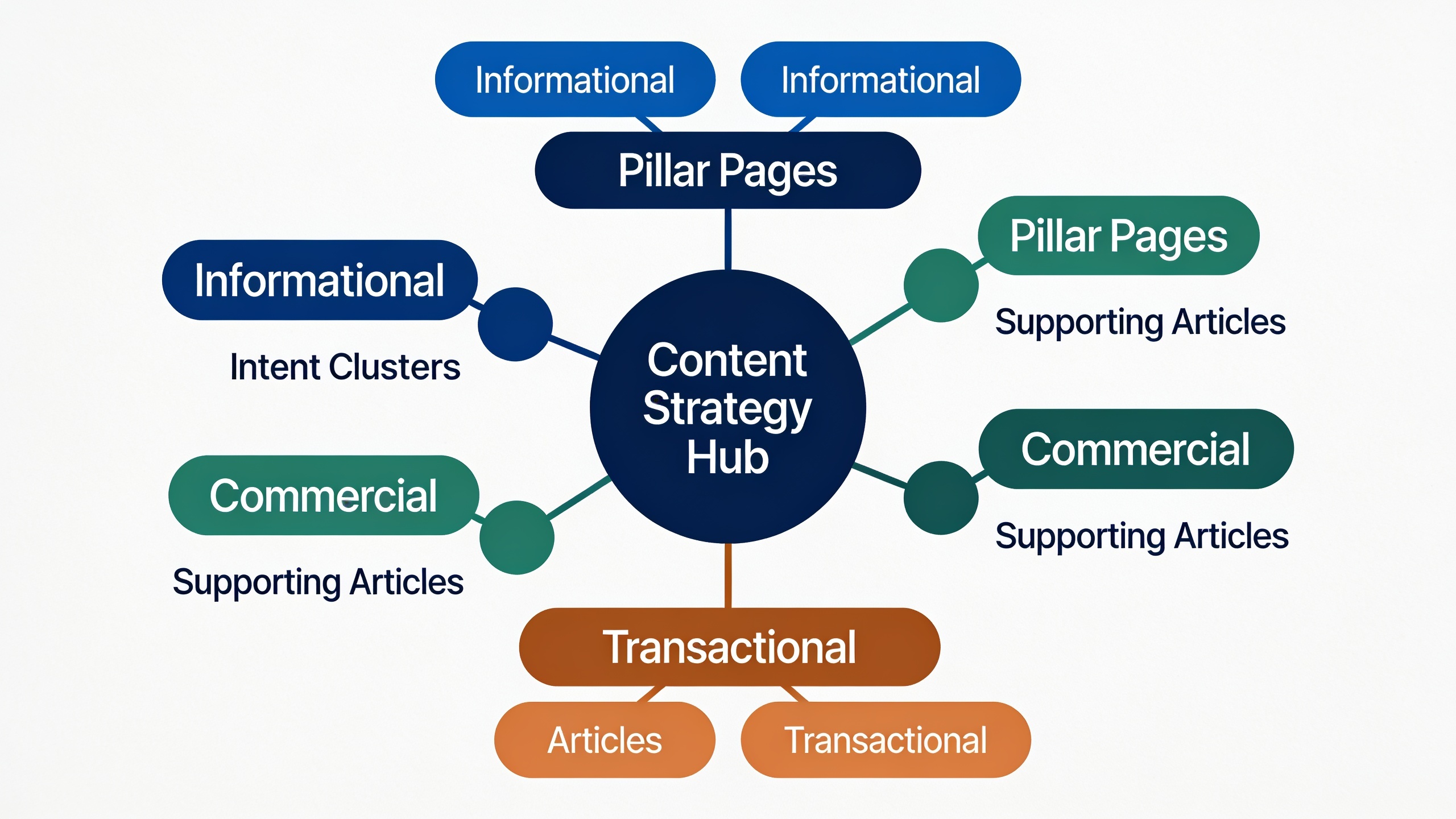
So what is it, really? Keyword clustering means grouping keywords that share the same or overlapping search intent so one page (or a small, deliberately linked set of pages) can target them, instead of a bunch of scattered posts all competing with each other. Pair that with search intent grouping, which just means sorting those keywords by what the person searching actually wants (to learn something, to compare, or to buy), and suddenly your messy keyword dump turns into an actual roadmap: pillar pages, supporting articles, internal links that make sense.
This guide covers what clustering actually is, how to do it step by step, how to map clusters onto pillar and supporting pages, and the mistakes that quietly wreck most clustering projects. Let's get into it.
Table of Contents
- What Is Keyword Clustering?
- Why Keyword Clustering Beats One-Off Blog Posts
- How Does Search Intent Grouping Work Inside a Cluster?
- How to Build a Keyword Cluster: A Step-by-Step Process
- Mapping Clusters to Pillar and Supporting Pages
- How Do You Turn Keyword Clusters Into a Content Roadmap?
- Common Keyword Clustering Mistakes to Avoid
- FAQ
What Is Keyword Clustering?
Keyword clustering is the practice of grouping keywords that a search engine treats as answerable by the same page, based on shared meaning or overlapping intent, instead of treating every little keyword variation as an excuse to publish another post. A cluster usually has one head term (the broad, high-volume keyword) with a bunch of long-tail variations, questions, and synonyms circling it, all pointing at the same underlying need.
Take "email marketing software," "best email marketing tools," and "top platforms for email marketing." Technically three different strings. But they're one intent: somebody comparing email marketing products. And here's the kicker. Google already knows this. Search any of those three and you'll get pretty much the same results back. Clustering just formalizes what the search engine figured out ages ago, so your team stops churning out three thin, duplicate-feeling articles when one solid page would beat all three.
The difference between clustering and plain old keyword research comes down to this: research gives you a list, clustering gives you a structure. The list tells you what people search for. The structure tells you how many pages you actually need and what each one is on the hook for. That second thing is the one that saves you.
Why Keyword Clustering Beats One-Off Blog Posts
Clustering beats the one-off approach because it kills keyword cannibalization, concentrates your topical authority on fewer stronger pages, and gives every article a defined role in a larger system instead of a lonely little existence. A site with twelve tightly clustered articles that cover a topic in full will usually out-rank a site with forty scattered, overlapping posts on the same subject. Search engines reward depth and clear structure, not article count. They never have rewarded article count, honestly, no matter how many blogs told you to "post more."
The one-off thing happens for a pretty understandable reason. Somebody spots a keyword with volume, notices there's no article for it, so they write one. Do that every week for a year and you end up with a site that has no hierarchy at all. Dozens of pages of roughly the same length and depth, a handful of them chasing near-identical intent, all elbowing each other in the results. That's cannibalization: two or more pages on your own domain competing for the same query, splitting your ranking signals instead of stacking them. You're essentially competing against yourself, which is about as dumb as it sounds when you say it out loud.
Clustering nips this in the bud. Group the keywords first and you can decide upfront that "email marketing software" gets one deep, authoritative pillar page, while "email marketing software for nonprofits" or "email marketing software with SMS" become supporting articles that link back to the pillar rather than fight it. This is also why clustering goes hand in hand with a real editorial calendar instead of ad hoc publishing. The piece on planning and publishing consistently with zero spare time gets into how founders can turn a cluster map into an actual schedule instead of a spreadsheet that rots in a Drive folder.

And there's a resourcing angle nobody talks about enough. Most marketing teams, especially at startups and small agencies, cannot write forty articles a quarter. That's just not happening. Clustering tells you which twelve articles actually matter, so your limited writing hours go toward pages that reinforce each other rather than pages that quietly eat each other's lunch.
How Does Search Intent Grouping Work Inside a Cluster?
Search intent grouping works by sorting the keywords inside a cluster by what the searcher wants to do, learn something, compare options, find a specific site, or buy, so each intent gets matched to the content format that satisfies it. Almost every topic cluster contains a mix of these, and treating them as interchangeable is one of the fastest ways to build a page that ranks for the wrong reason and converts absolutely nobody.
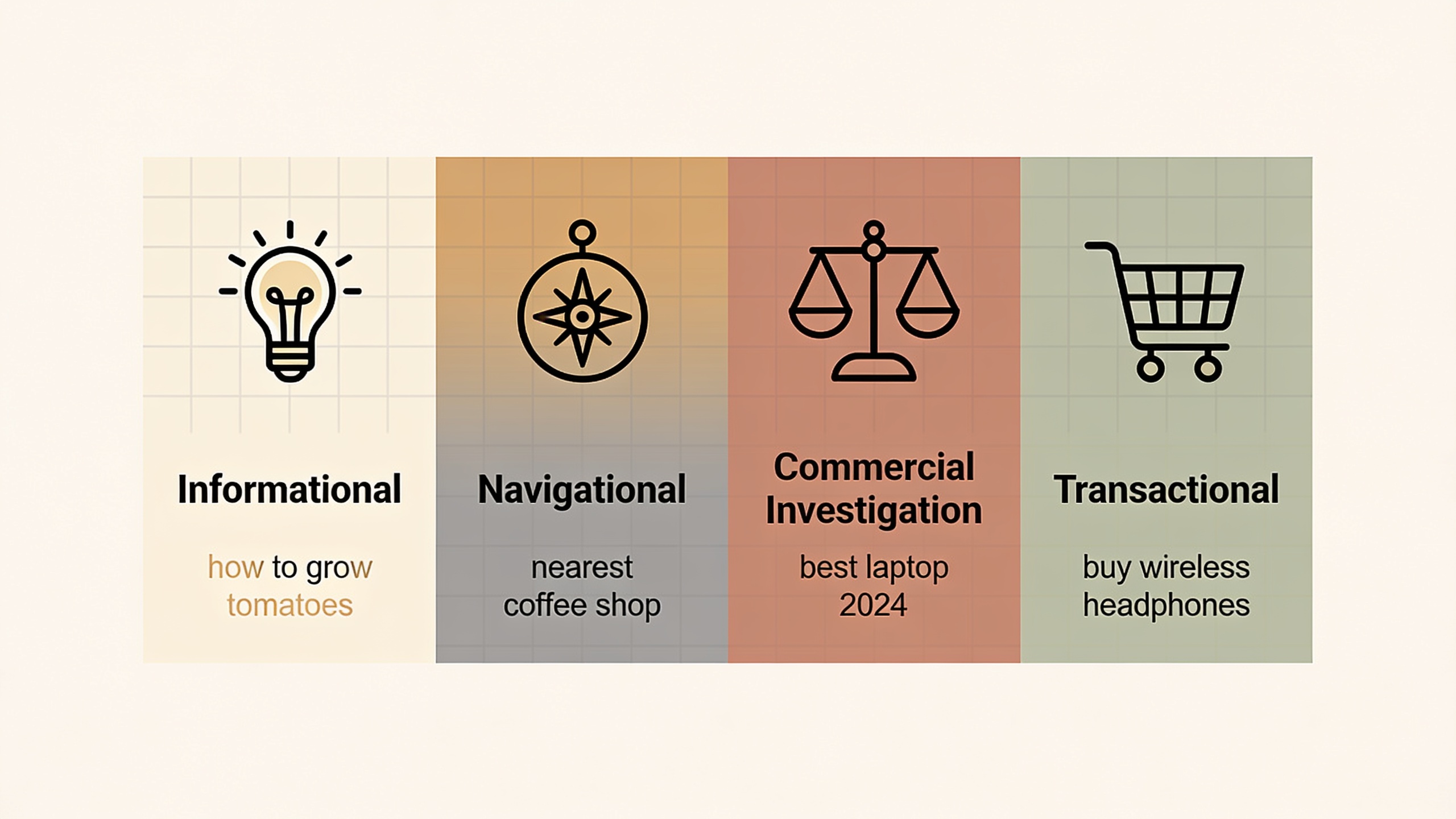
The four intent buckets most SEOs use go all the way back to the classic informational / navigational / transactional / commercial framework:
- Informational — the searcher wants to learn or understand ("what is keyword clustering," "how does search intent affect SEO")
- Navigational — the searcher wants a specific site or brand ("robinrank pricing," "ahrefs login")
- Commercial investigation — the searcher is comparing options before deciding ("best keyword clustering tools," "keyword clustering software vs manual")
- Transactional — the searcher is ready to act ("buy keyword research tool," "sign up for SEO software")
Grouping by intent, and not just by "these words look similar," is what tells you the format each page needs. A cluster around "keyword clustering" might have a mostly informational head term but also several commercial long-tails comparing tools. Those belong on a different page, or at least a different section of the pillar, than a pure definition-style query. Cram them together and you get mush.
| Search Intent | What the Searcher Wants | Example Keyword | Best-Fit Content Format |
|---|---|---|---|
| Informational | Learn a concept or answer a question | "what is keyword clustering" | Definitional guide, how-to article, FAQ page |
| Navigational | Reach a specific brand or tool | "robinrank blog" | Homepage, branded landing page |
| Commercial investigation | Compare options before deciding | "best keyword clustering tools" | Comparison post, listicle, feature table |
| Transactional | Take an action now | "sign up for SEO software" | Product page, pricing page, signup flow |
Mismatching intent and format is where a ton of pages die. A comparison-style listicle written for a purely informational query feels padded and sales-y to both readers and search engines. And a thin definition page trying to rank for a commercial query? It won't satisfy people who wanted the options laid out side by side. Intent grouping is basically what keeps each page honest about the job it's supposed to be doing.
This matters more than it used to, too, because the results pages themselves have changed. Featured snippets, AI Overviews, all that stuff, they increasingly answer simple informational queries right there on the page, which means some keywords in a cluster might never send you a click at all. There's more on that shift in how rising zero-click searches are changing content strategy. Clustering by intent helps you spot which keywords are worth chasing for direct traffic and which are better off as supporting context inside a bigger page that catches the commercial and transactional searches around the same topic.
How to Build a Keyword Cluster: A Step-by-Step Process
Building a cluster means starting from a broad seed topic, blowing it out into a full keyword list, grouping that list by shared intent and SERP overlap, and then handing each group off to a specific page. Works the same whether you do it in a spreadsheet or with clustering software. The logic doesn't change, only the speed.
Step 1: Choose a Seed Topic
Start with a broad subject that matters to the business. Not a single keyword, a topic area. Think "email marketing," "local SEO," "keyword research." This seed is what eventually becomes (or feeds into) your pillar page.
Step 2: Expand the Keyword List
Now pull every related keyword you can dig up. A keyword tool, Google's "People also ask" boxes, autocomplete suggestions, your competitors' content, all of it. At this stage you want raw material, quantity over precision. You'll trim it down later, so don't overthink it.
Step 3: Group by SERP Overlap and Intent
This is the actual clustering, the part that matters. Two ways people do it:
- Manual / SERP-overlap method: search each keyword and see if Google returns basically the same top 10. Significant overlap (several shared URLs) is a strong sign those keywords share intent and belong together.
- Semantic / tool-assisted method: let a clustering feature in your keyword or SEO platform group terms algorithmically by topical similarity, then have an actual human review the groupings before you commit to anything.
Neither one is "correct" in some absolute sense. Smaller sites with short keyword lists usually do fine clustering by hand. Agencies juggling dozens of client accounts pretty much need tooling to pull this off at scale. Use what fits.
Want content like this running on autopilot for your own site? Try RobinRank free — AI-written, SEO-optimized articles generated and published automatically, no credit card required.
Step 4: Label Each Group by Intent
Once your keywords are grouped, tag each cluster with its dominant intent (informational, commercial, transactional, navigational) using the framework from up above. This is what decides the content format before anyone writes a word. Don't skip it. Seriously.
Step 5: Identify the Head Term and Supporting Terms
Inside each cluster, pick the keyword with the highest volume and broadest phrasing as your head term for the main page. Everything else becomes either a subheading inside that page or the seed for its own linked supporting article. The deciding factor is how much unique depth that sub-topic actually deserves. Not much? It's a subheading. A lot? It gets its own page.
Mapping Clusters to Pillar and Supporting Pages
Mapping a cluster to a content structure means giving your broadest, highest-intent keyword to one comprehensive pillar page, and handing the narrower, more specific keywords to supporting pages that link back to it. The pillar is your central, authoritative resource on a topic. Supporting pages (some people call them cluster content) go deeper on individual sub-questions and funnel both readers and link equity back to the pillar through internal links.
Using "keyword clustering" as the seed, here's roughly how that shakes out:
- Pillar page: "Keyword Clustering: How to Plan Content Around Search Intent" — covers the whole topic broadly, links out to every supporting piece
- Supporting page: "Keyword Clustering Tools Compared" — commercial-investigation intent, a real deep dive on software
- Supporting page: "How to Fix Keyword Cannibalization" — informational, tackles a specific problem the pillar only brushes against
- Supporting page: "Search Intent Types Explained With Examples" — informational, expands one idea the pillar mentions in passing
Every supporting page links back to the pillar, and the pillar links out to each supporting page from the relevant spot. That's your hub-and-spoke pattern, and it's what concentrates topical authority. Search engines can see the pillar is the definitive resource because a bunch of related pages on your own site all point at it. Simple, but it works.
So how do you decide whether a keyword gets folded into the pillar or split into its own page? Two questions. Does this sub-topic have enough unique search volume and depth to hold up a standalone page? And does it have a meaningfully different intent than the pillar? Yes to both, it earns its own page. Otherwise it becomes a well-developed section of the pillar instead of a thin, redundant post nobody needed.
| Approach | Best For | Typical Effort | Risk If Done Poorly |
|---|---|---|---|
| Manual SERP-overlap clustering | Small sites, single niche, limited keyword lists | High time investment, low cost | Missed overlaps, inconsistent grouping |
| Spreadsheet-based semantic grouping | Mid-size sites, agencies with several clients | Moderate — needs a clear process | Groupings feel arbitrary without a documented method |
| Tool-assisted / AI-driven clustering | Larger keyword sets, ongoing content programs | Low time investment, requires tool cost | Over-trusting automated groupings without human review |
None of these gets you off the hook from actually thinking. Whatever method spits out your initial groupings, somebody still has to check that the resulting pillar-and-supporting structure matches how real people think about the topic, not just how a spreadsheet formula happened to group some strings of text. Tools are great. They are not a brain.
How Do You Turn Keyword Clusters Into a Content Roadmap?
Clusters turn into a roadmap once each pillar and its supporting pages get sequenced, assigned a publish date, and prioritized by business value and competitiveness instead of published in whatever random order you feel like. Clustering answers "what should we write about." The roadmap answers "in what order, and why now."
The sequencing logic I lean on:
- Publish the pillar first, even if it's not perfect. It plants the URL and topical anchor everything else links back to. Waiting for it to be flawless is how projects stall forever.
- Prioritize supporting pages by a mix of volume and competitiveness. Lower-competition, decent-volume terms are usually faster wins than the highest-volume monster in the cluster.
- Update the pillar as supporting pages go live. Add fresh internal links from the pillar out to each new article so authority flows both directions.
- Batch clusters by business priority, not just difficulty. A cluster tied to a core product line deserves an earlier slot than some tangential topic with slightly more search volume. Volume isn't everything. Revenue matters more.
This is exactly where clustering and calendar planning collide. A cluster map with no publishing cadence is just a research doc gathering dust, and a cadence with no cluster logic is just a list of disconnected topics. You need both. That gap is the whole point of building a content calendar for founders with zero spare time, turning a cluster map into a realistic weekly or monthly rhythm instead of a one-time planning session that never actually ships anything.
Once you're publishing consistently, the internal linking inside each cluster starts pulling double duty as a way to earn external links too. A strong pillar page is a natural thing for other sites to reference or link to. A manually reviewed backlink exchange network like RobinRank's can help surface those placements: you request a link to a specific page with a specific anchor, offer a reciprocal link back, and the platform verifies the live placement on both sides. Feeding your pillar pages (the ones built specifically to be the definitive resource on a topic) into that kind of effort makes way more sense than firing link requests at thin one-off posts that were never meant to carry any authority in the first place.
Common Keyword Clustering Mistakes to Avoid
The single most common mistake is grouping keywords by surface-level word similarity instead of actual search intent. It produces clusters that look nice and tidy in a spreadsheet but don't match what searchers or search engines actually want. There are a few other repeat offenders I see constantly, especially from teams doing this for the first time.
Clustering by keyword string instead of by SERP results. Two phrases can share a bunch of words and still have totally different intent. "Keyword research tool" and "keyword research process" look almost identical, but the first is commercial and the second is informational. Actually checking the search results, not just word overlap, catches this every time.
Skipping the intent tag. A cluster with no assigned intent leads straight to a mismatched format. Somebody writes a listicle for a query that wanted a plain definition, or a two-sentence definition for a query that was begging for a full comparison. Tag it. It takes thirty seconds.
Building too many thin supporting pages. Not every long-tail variation needs its own URL. I promise. When five keywords all have low individual volume and near-identical intent, they belong inside one page as subheadings, not five separate thin articles fighting over the same scraps.
Never touching the pillar again. A pillar is not a publish-and-forget asset. As supporting pages go live, it needs fresh internal links and, every so often, a content refresh. An outdated pillar quietly loses its status as your site's go-to resource, and you won't notice until the rankings slip.
Ignoring commercial intent buried in informational clusters. Even a mostly informational topic usually has a few commercial-investigation keywords mixed in ("best tools for X," "X software comparison"). Miss those and you miss the pages that are usually the easiest to actually monetize, which is a weird thing to leave on the table.
FAQ
What's the difference between keyword clustering and keyword grouping?
People use them interchangeably a lot, but there's a subtle difference. "Keyword clustering" usually implies grouping by shared search intent or SERP overlap, an actual method for deciding the groupings. "Keyword grouping" sometimes just means dumping keywords into loose topical buckets without ever checking whether they truly share intent. For real SEO planning, the intent-based method is the one that gives you a structure you can actually use.
How many keywords should be in one cluster?
There's no magic number, and anyone who gives you one is guessing. It depends entirely on how many distinct sub-questions or angles live inside the topic. A narrow cluster might have five to ten keywords feeding one page. A broad pillar topic could have fifty or more spread across a pillar and five to ten supporting pages. The real test isn't the count, it's whether every keyword in the group genuinely shares intent with the others. That's it.
Can keyword clustering hurt SEO if done wrong?
Yeah, it can. Clustering keywords that don't actually share intent onto one page gives you a page that half-satisfies several different searches and fully satisfies none of them, and that tends to underperform against well-targeted individual pages. The fix is boring but reliable: check actual SERP overlap or intent before merging keywords, and stop assuming similar wording means similar intent. It often doesn't.
Do I need special software to do keyword clustering, or can I do it manually?
Manual works totally fine for smaller keyword sets. Checking SERP overlap by hand for a few dozen terms is very manageable, no tool required. It gets brutal past a few hundred keywords, though, and that's where the clustering features built into keyword and SEO platforms start earning their keep. Just make sure a human still reviews the groupings before they become a content plan. The tool doesn't get the final say.
How does search intent grouping affect which keywords are worth targeting at all?
Intent grouping helps you figure out which keywords in a cluster will actually drive clicks versus which ones are likely to get answered right on the results page through featured snippets or AI summaries. Purely informational, single-fact queries are the ones most likely to get absorbed by those on-page answers. Commercial-investigation and transactional queries still tend to need a click. That's a genuinely useful filter when you're deciding which keywords deserve their own dedicated page and which just get a quick mention inside a bigger piece.
---
Keyword clustering isn't a one-and-done research exercise. It's the planning layer that sits between a raw keyword list and an actual content calendar. Group by intent first, map the groups to pillar and supporting pages second, and then start assigning publish dates. Skip those first two steps and even the most disciplined publishing schedule ends up stuffed with pages competing against each other instead of building on each other. And that's the whole ballgame.
Ready to stop writing content by hand? Start your free RobinRank trial and get a full month of SEO-optimized articles published on autopilot.