Multi-Author Blog Brand Voice: How to Keep Every Post Sounding Like One Brand

Table of Contents
- What Is a Multi-Author Blog Brand Voice, and Why Does It Break Down?
- Why Consistent Tone Matters More for Content Teams Than Ever
- How Do You Build a Style Guide That Writers Actually Follow?
- Managing AI-Generated Posts Without Losing Brand Voice
- Editorial Workflows That Protect a Unified Voice
- Signs of Voice Drift and How to Fix Them
- Common Mistakes That Undermine a Multi-Author Blog Brand Voice
- Frequently Asked Questions
What Is a Multi-Author Blog Brand Voice, and Why Does It Break Down?
A multi-author blog brand voice falls apart when every contributor shows up with their own default writing habits and there's no shared standard sitting on top to override them. Sentence length, formality, how much humor they use, whether they lean into opinions or stay neutral. All of that varies person to person. And when nothing reins it in, you end up with a blog that reads like a bulletin board full of individual writers instead of one publication that actually has a point of view.
This is the thing that never happens on a solo blog. When one person writes everything, voice consistency is automatic. There's only one brain making stylistic decisions. But the second you add a coworker, a freelancer, or an AI tool into the mix? Every little sentence-level choice becomes a variable. One writer loves short punchy sentences and talks straight to the reader ("you'll want to..."), while the next one defaults to this passive, kind of academic phrasing that feels three degrees removed from a human. Readers pick up on the mismatch even when they can't name it. It just registers as a nagging sense that the brand feels a little unpredictable. A little less trustworthy.
And there's an SEO cost to all this too. Search engines and AI answer engines are increasingly rewarding sites that show real topical authority and a coherent editorial identity. A blog that reads like a fragmented mess gives both humans and algorithms fewer reasons to treat the site as one credible authority instead of a loose pile of guest posts.
Why Consistent Tone Matters More for Content Teams Than Ever
Consistent tone matters more now because teams are publishing faster, blending human and AI contributors way more often, and fighting for reader trust in a landscape that's noisier than it was five years ago. If a content team can't hold a stable voice at scale, it starts diluting the exact brand recognition content marketing is supposed to build in the first place. Kind of self-defeating.
Think about what actually happens during one visit to a blog. Someone lands on a listicle a freelancer wrote, clicks over to a product comparison that was drafted with AI help, then reads a founder's opinion piece. All in maybe ten minutes. If those three pieces sound like they came from three different companies, then the brand identity that's supposed to get reinforced with every page view gets chipped away instead.
There's a boring practical reason this matters too, especially for agencies and startup founders running lean: consistency saves editing time. When contributors already know the tone, the vocabulary, and the structural rules before they write a single word, editors spend less time rewriting sentences and more time on facts and strategy. For teams without a big in-house editorial staff, that's a genuine efficiency win, not a nice-to-have.
Then there's the audience side of it. A blog serving both enterprise buyers and small business owners needs a voice flexible enough to talk to wildly different levels of reader sophistication while still sounding like it came from one source. That flexibility is tricky, and it connects to how tone shifts depending on who's reading. There's a lot more on that in this comparison of B2B and B2C content marketing approaches, which digs into how buying behavior and formality expectations change based on your audience.
How Do You Build a Style Guide That Writers Actually Follow?
A style guide people actually follow is specific, packed with examples, and short enough to skim in under five minutes. Not a 40-page manual that gets opened once during onboarding and never again. What you want is a living document that answers the real questions a writer hits while drafting, not a list of vague brand adjectives like "friendly" or "bold."
Define Voice With Examples, Not Adjectives
Telling a writer your brand voice is "professional but approachable" is a fine starting point, but on its own it's basically useless. Pair every descriptor with a side-by-side example. Here's the sentence done right, here's the same sentence done wrong. Writers learn from contrast way faster than they learn from description. Honestly this one change does more than half the guide combined.
Cover the Mechanical Layer
Beyond tone, a guide worth its salt locks down the small mechanical stuff that quietly screams "inconsistent" when it's left open. Things like point of view (do we say "you," "we," or stay in neutral third person?), whether you use the Oxford comma, sentence case versus title case for headings, and how numbers get formatted. Add how you cite stats and sources inline, your preferred and banned terminology ("customers" vs. "users," and please no internal jargon), and how lists, subheads, and CTAs should be formatted. None of this is glamorous. All of it matters.
Assign an Owner
Every style guide needs a named owner. Usually a senior editor or content lead. Someone who gets the final call when there's a dispute over whether a piece matches the brand voice. Without an owner, the guide quietly becomes "advisory" instead of enforced, and the inconsistencies creep right back in within a couple of publishing cycles. I've watched it happen more than once.
Here's how these pieces usually shake out in a working style guide for a multi-contributor blog.
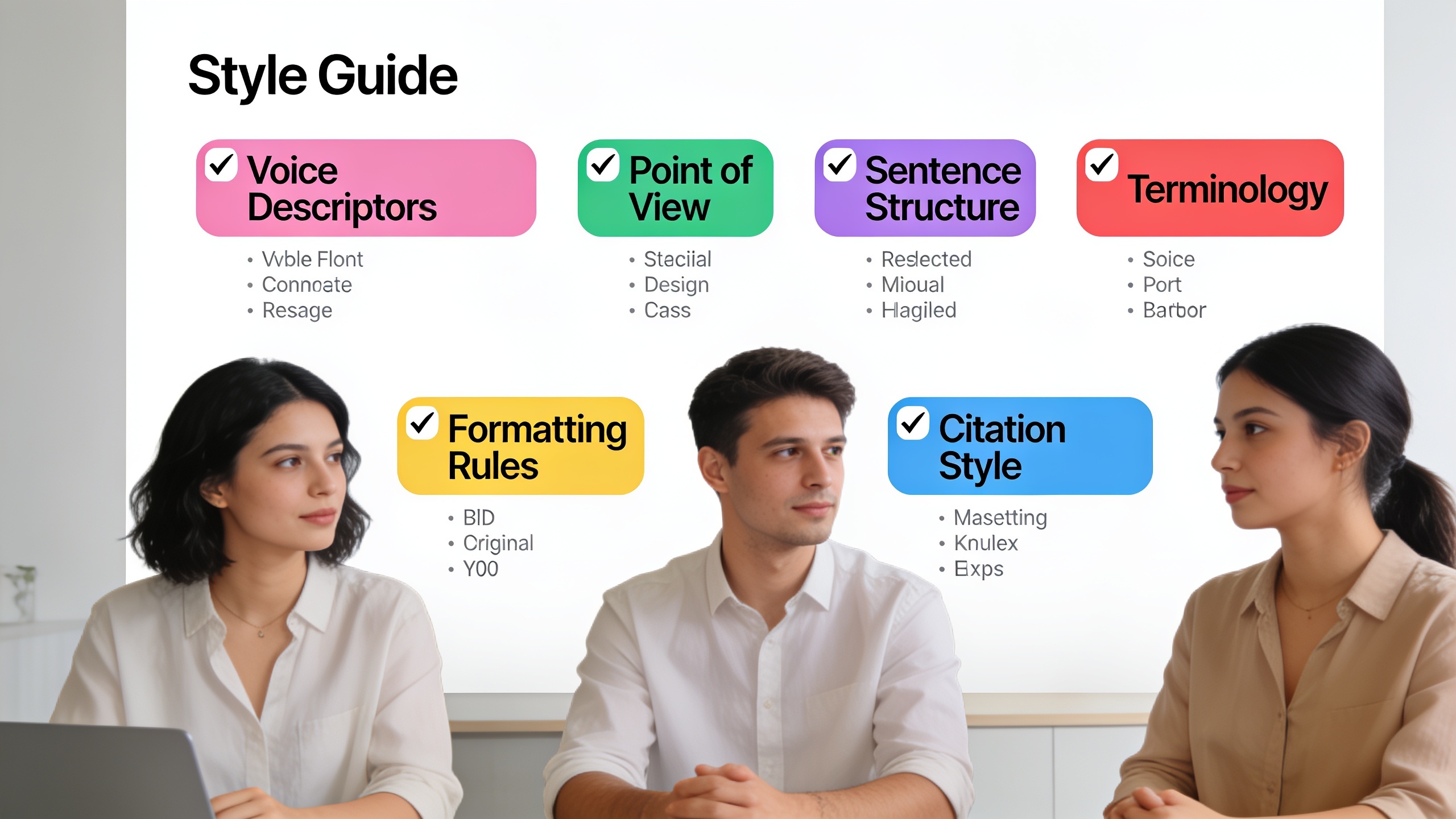
| Style Guide Element | What It Controls | Example Rule |
|---|---|---|
| Voice descriptors | Overall personality of the writing | "Professional but approachable — explain like a knowledgeable colleague, not a textbook" |
| Point of view | Reader address | Use "you" for advice content; avoid "one might consider" |
| Sentence structure | Readability and pacing | Average sentence length under 20 words; vary rhythm |
| Terminology list | Brand-consistent word choice | "Content team" not "content squad"; "SEO professionals" not "SEO gurus" |
| Formatting rules | Visual consistency | H2 for main sections, sentence case, no more than one bullet list per 500 words |
| Citation style | Trust and credibility | Statistics always named inline with source and year |
| Tone boundaries | What to avoid | No hard sales language inside educational posts; no unverified claims |
Managing AI-Generated Posts Without Losing Brand Voice
AI-generated posts stay on-brand when the AI gets the same style guide, examples, and guardrails you'd hand a human writer. Treat it like a contributor you're onboarding, not a shortcut that gets to skip your editorial standards. Skipping that step is the single most common reason AI content on a multi-author blog sticks out like a sore thumb next to everything else.
In practice that means giving the model explicit tone instructions (formality level, point of view, how long you want the sentences), a glossary of preferred terms, and ideally a few "gold standard" posts that nail your ideal voice. A lazy prompt like "write in a professional tone" gives you lazy, generic output. But specific prompts anchored to real examples? Those get you something a lot closer to what an editor would actually approve without gutting it.
Want content like this running on autopilot for your own site? Try RobinRank free — AI-written, SEO-optimized articles generated and published automatically, no credit card required.
It's also worth nailing down an internal policy on how AI-assisted content gets disclosed, edited, and attributed, because this bleeds into bigger questions about who owns the stuff. If you're publishing AI-drafted posts, you really want to understand the ownership and rights side before you scale production up. There's a full breakdown of that in this look at who actually owns AI-generated content.
RobinRank, an AI-powered SEO platform, is built to automatically write, optimize, and publish articles for businesses. Which means this exact voice-consistency question lands right in the lap of any team using AI content tools at scale. The model needs the same brand guardrails you'd give a human freelancer, applied the same way across every article it churns out, so the whole thing reads as one voice instead of a stack of disconnected drafts.
Human Review Is Still Necessary
Even with great prompting, AI drafts should go through the same human review as anyone else's work. No exceptions. An editor checking for voice should be asking an AI draft the exact same questions they'd ask a freelancer's draft: Does this sound like us? Could a reader tell this didn't come from our usual team? If the answer to that last one is yes, you've got work to do.
Editorial Workflows That Protect a Unified Voice
An editorial workflow protects voice by slipping a dedicated "voice check" step in between drafting and publishing, separate from fact-checking or SEO review. That way tone problems get caught before a post goes live instead of after readers (and search engines) have already seen the mess.
Brief before drafting. Give every contributor, human or AI, a brief with the target audience, the intended tone for that specific piece, and links to two or three reference posts that show the style you want. And yeah, a technical how-to and a thought-leadership rant might sit in slightly different registers even inside the same overall voice. That's fine. Just say so upfront.
Draft against a checklist. Contributors self-review before they submit. Did I follow the terminology list? Did I stay in the sentence-length range? Did I dodge the banned phrases? This catches the most obvious drift before an editor even opens the file, which saves everyone a headache.
Do a voice pass that's separate from copyediting. A lot of teams roll voice review, grammar, and SEO into one editing pass. Efficient, sure. But risky. Voice slips are so easy to miss when you're also hunting for typos and checking keyword placement. A quick, dedicated read just for voice, ideally by whoever owns the style guide, catches stuff a combined pass blows right past.
Keep a feedback loop. When an editor changes something for voice reasons, log it. And if it turns out to be a pattern instead of a one-off, add it to the guide. Over time this turns your style guide into a document shaped by real editorial decisions rather than guesses somebody made before a single post existed. That's when it actually gets good.
Signs of Voice Drift and How to Fix Them
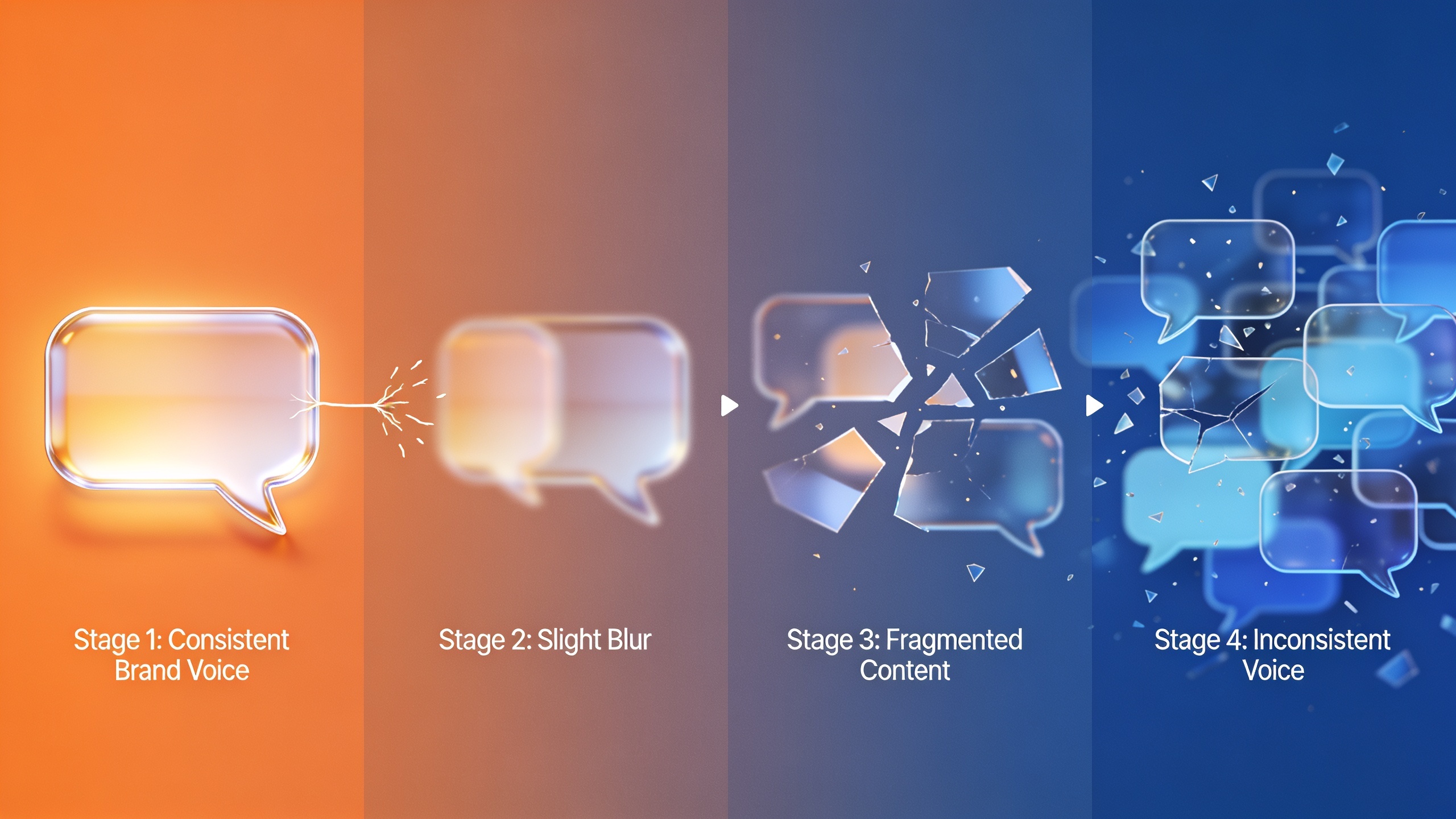
Voice drift is the slow, usually-unnoticed way a blog's writing wanders away from its own style guide, and it's typically the fault of new contributors, sloppy onboarding, or plain editorial fatigue. It's almost never one dramatic blowup. It builds post by post until the blog's whole identity goes fuzzy and you can't quite say when it happened.
| Sign of Drift | Likely Cause | Fix |
|---|---|---|
| Formality level swings between posts | No documented formality range in the style guide | Add explicit formality examples (too stiff / too casual / just right) |
| Inconsistent terminology for the same concept | No shared glossary, or glossary not enforced | Maintain a living terminology list; check it during editorial review |
| Some posts feel salesy, others purely educational | No shared guidance on CTA placement and tone | Define where and how CTAs appear across content types |
| AI-generated posts read noticeably different from human posts | AI prompts lack brand-specific examples and guardrails | Feed the model example posts, terminology, and explicit tone rules |
| New contributors take months to "sound right" | No onboarding document, only informal mentoring | Create a concise onboarding style guide with examples, not just rules |
Common Mistakes That Undermine a Multi-Author Blog Brand Voice
The most damaging thing a content team does is treat the style guide as a one-and-done document instead of a living editorial tool that gets revisited as the team, audience, or content mix shifts. A guide written once and then abandoned slowly turns into a museum piece while new content types, new contributors, and new channels pile up around it.
Second mistake, and this one's sneaky: over-indexing on grammar and SEO checks while skipping voice review entirely, because someone assumed "good writing" automatically means "on-brand writing." It doesn't. A grammatically spotless, perfectly optimized post can still sound completely wrong for the brand if nobody specifically checked it against the voice guidelines. Clean isn't the same as correct.
Third one is inconsistent onboarding. Some new writers get the full detailed rundown, others get a two-minute verbal summary and a "you'll figure it out." That gap guarantees drift. If you want consistency across a team, every contributor gets the same foundational guidance no matter how they were hired or how long they've been around.
And finally, a lot of teams confuse voice consistency with content-type rigidity. Not every post has to share the same structure. A data-heavy report and a quick opinion piece are going to look different, and they should. But they still need the same underlying personality, the same vocabulary preferences, the same quality bar. When editors mix up "consistent voice" with "identical structure," they end up over-correcting and flattening content that honestly should've had some room to breathe within the brand's boundaries.
Frequently Asked Questions
How many writers can a blog have before the voice gets hard to manage?
There's no magic number, and honestly it's the wrong thing to obsess over. It comes down to whether you've got a documented style guide and a real review process, not headcount. A blog with three undocumented contributors can drift just as badly as one with fifteen well-onboarded writers, as long as those fifteen all reference the same guide and pass through the same check.
Should AI posts get edited differently than human ones?
The fact-checking and voice-review steps should be identical for both. The real difference is in the prep. AI tools need explicit, example-based prompting to even approximate your voice, since they don't build up the implicit brand familiarity a long-time human writer eventually develops.
How often should I update the style guide?
Most teams revisit it whenever a recurring correction pattern pops up. If editors keep fixing the same terminology issue across a bunch of posts, that's your signal the guide needs an actual rule for it instead of somebody manually correcting it every single time.
Does the voice need to change for different formats, like listicles vs. opinion pieces?
The underlying personality and vocabulary should stay put, but formality and structure can flex inside that. A how-to guide and a founder's opinion piece can both sound unmistakably like the same brand while landing at different tone intensities and formats. Same voice, different volume.
Can a small team without a dedicated editor still pull this off?
Yeah, but it hinges on having a documented guide with real examples so contributors can self-check before hitting submit, since there might not be an editorial pass to catch everything. Founders and small business owners running a blog solo (or with a couple of freelancers) get the most out of putting the time in upfront on a short, example-heavy guide rather than leaving feedback after the post's already published and it's too late to matter much.
---
Keeping a multi-author blog brand voice consistent was never about forcing everyone to sound like a clone of each other. It's about handing every contributor, human or AI, the same reference points so their individual strengths still add up to one recognizable brand. A documented style guide, a real voice-review step, and the habit of feeding lessons learned back into that guide. That's the whole difference between a blog that reads like one authoritative publication and one that reads like a patchwork of guest posts nobody bothered to stitch together.
Ready to stop writing content by hand? Start your free RobinRank trial and get a full month of SEO-optimized articles published on autopilot.