Organic Traffic Case Study: How a 3-Person Startup Tripled Organic Traffic in 90 Days

The longer version: a bootstrapped startup with a founder, a part-time marketer, and a freelance developer grew organic sessions about 3x in a single quarter by pairing automated content publishing with a manual backlink exchange network. The founder asked me to scrub the names and a few identifying details, which is fine. What matters is the sequence and the tactics, and honestly, the pattern here is one I keep seeing with small teams that want SEO growth but can't afford to spin up a whole content department.
So if you're running a lean shop and you've been quietly wondering whether SEO is even worth attempting without hiring writers, editors, and link builders, this one's for you. I'll walk through where they started, what they actually did week by week, what they measured, what blew up in their faces, and what you can realistically steal for yourself.
Table of Contents
- What This Organic Traffic Case Study Reveals About Startup SEO Growth
- Who Was the Team, and What Was Their Starting Point?
- The 90-Day Growth Strategy
- The Results: Traffic and Ranking Metrics by Milestone
- How Much Did This Startup SEO Growth Strategy Cost?
- What Went Wrong (and What the Team Learned)
- How to Replicate This Case Study for Your Own Startup
- FAQ
What This Organic Traffic Case Study Reveals About Startup SEO Growth
The big takeaway is that small teams don't actually need a content department to move organic traffic fast. What they need is a repeatable publishing system and a way to earn backlinks that doesn't hinge on cold-emailing strangers. This startup had no SEO hire, no in-house writer, and zero budget for a link-building agency. What it had was a founder willing to spend a couple of hours a week reviewing content and green-lighting backlink requests. That's it.
Two levers did the heavy lifting: volume and authority. Volume came from publishing consistently instead of whenever someone felt like it. They went from maybe one post a month to several a week. Authority came from getting links off real, active websites, not from spammy directories or those sketchy guest-post farms everyone pretends they don't use.
And neither lever works on its own. This is the part people get wrong. Content with no links tends to flatten out and just... sit there. Links with no fresh content have nothing new to point at. It's the combination that compounds. You want the growth curve that bends upward in month three, not the one-time spike that dies by Friday.
You'll see almost the same shape in a related case study on a legal services firm that tripled organic leads, where another tiny team paired steady publishing with targeted link acquisition instead of treating either one as a standalone play.
Who Was the Team, and What Was Their Starting Point?
Picture a bootstrapped B2B software company with three people, each wearing about four hats. The founder ran product and strategy. The part-time marketer split their week between paid ads and content. The freelance developer kept the website from falling over. Before the 90-day sprint, the site pushed out new content maybe once every four to six weeks, had a thin backlink profile built mostly off a single startup-directory launch, and organic traffic that just flatlined month after month.
Their constraints were the ones basically every early-stage team knows by heart. No budget for a full-time writer or SEO specialist. No existing relationships with other site owners, so cold outreach was the only obvious path (and nobody wanted to do it). The marketer could spare maybe five to eight hours a week for SEO on top of everything else. And there was this graveyard of topic ideas that never became articles, because writing and editing each one took forever.
Their goal wasn't "do SEO," whatever that means. It was more practical: stop leaning so hard on paid acquisition, which was getting pricier as customer acquisition costs crept up. Organic was the cheapest lever nobody had touched. They just needed a way to pull it without hiring anyone.
The 90-Day Growth Strategy
Two pillars, running side by side from day one. Automated content publishing to crank up the number of indexable pages, and a manual backlink exchange network to boost the authority of the domain those pages lived on. Here's how each one actually played out, and why they fed each other.
Step 1: Automating Content Production
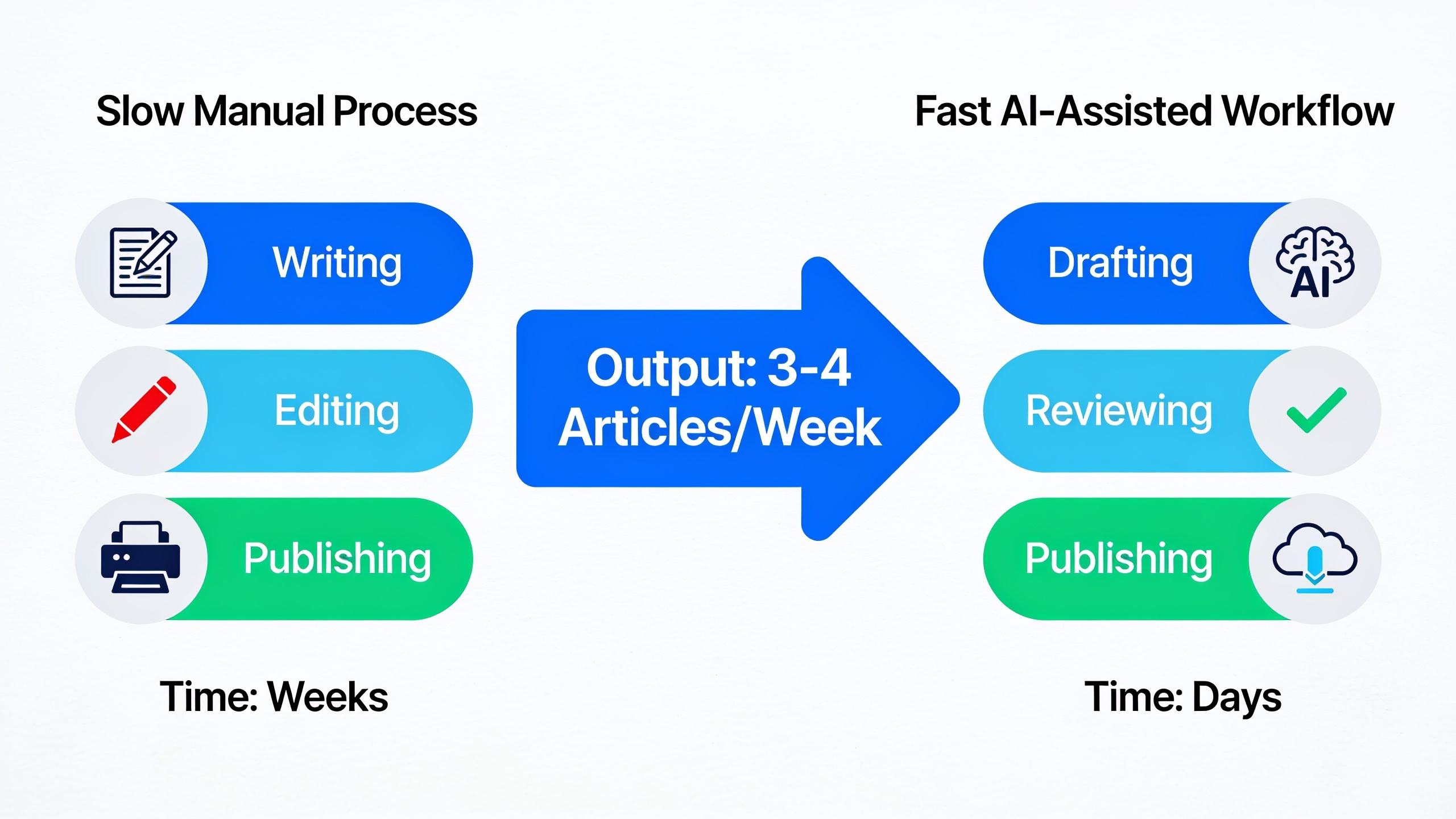
The marketer's first move was ditching the ad-hoc writing grind for an AI-assisted publishing workflow that could draft, optimize, and publish without a full editorial cycle for every single post. Instead of burning days per article on research, drafting, and formatting, they used the tool to spin up structured drafts around keywords the founder cared about, then spent their time reviewing rather than writing from a blank page.
That completely changed the math. When writing ate the marketer's whole week, one article a month was the ceiling. With the review-and-publish workflow, they were shipping three to four a week. And that cadence, not some viral home-run post, was what put new landing pages in front of searchers during the sprint.
Two decisions mattered more than the rest. First, they went after topics with clear commercial or informational intent tied to their product category, not big fat competitive keywords they had no shot at. Second, they kept a human in the loop. The founder read every draft before it went live, both for accuracy and to make sure nothing overstated what the product actually did. That review step, by the way, got more important as volume climbed. Automated drafts still needed a founder's domain knowledge stamped on them before publishing.
Step 2: Joining a Backlink Exchange Network
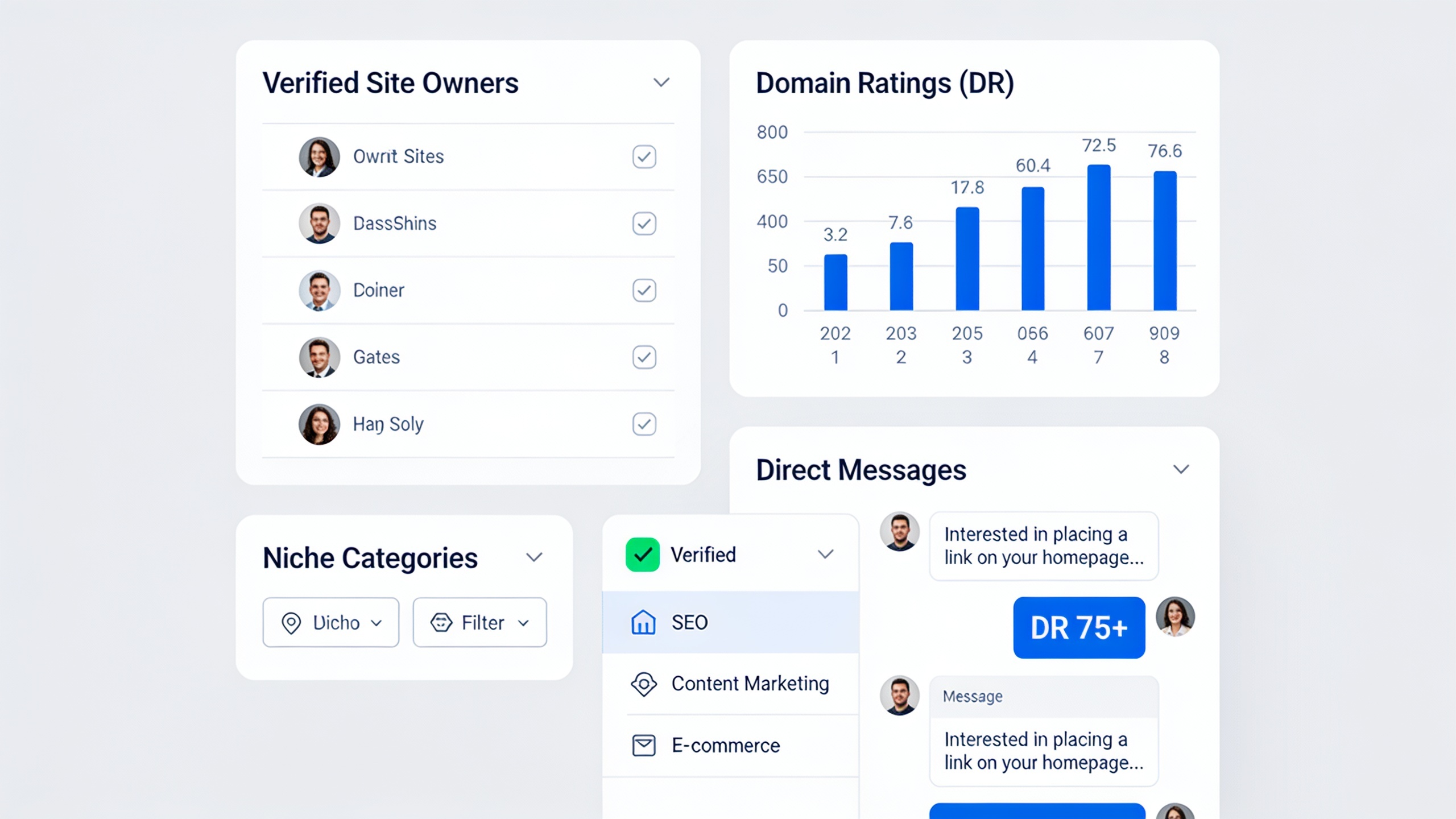
Meanwhile, they tackled the harder problem: getting links from real websites without spending weeks begging strangers over email. Instead of building an outreach list and firing off cold pitches, they joined a backlink exchange network. Think of it as a system where verified site owners request placements from each other directly, offer a link back in return, and the platform actually confirms the link is live on the page before it counts.
Let me be specific about what that means, because "backlink network" makes people nervous. In this case it's a marketplace-style directory of manually reviewed websites, filtered by a minimum Domain Rating of 5 or higher per Ahrefs, where members browse by niche and authority, message an owner directly to ask for a placement, and offer a reciprocal link. It's different from old-school link building in two ways. There's no cold-email dance, since both people already know why they're there. And every completed swap gets verified: the platform crawls the live page to confirm the href actually exists, instead of trusting a screenshot or a "yeah it's up, promise."
Over the 90 days, the marketer spent roughly one to two hours a week browsing relevant niche sites by Domain Rating, sending placement requests with a specific target page and anchor text, and haggling over reciprocal links when it made sense. Not every request landed. Some threads just went quiet. Some owners passed or wanted a different page. But a solid chunk of those conversations turned into published, verified links over the sprint.
This lines up with what happened in a separate case study on an agency that tripled client backlinks using an exchange network, where direct owner-to-owner requests converted into live placements way more reliably than blind outreach, mostly because both sides had already opted into the whole trading dynamic.
Want content like this running on autopilot for your own site? Try RobinRank free — AI-written, SEO-optimized articles generated and published automatically, no credit card required.
Step 3: Combining Both for Compounding Effect
Here's why the two pillars beat either one alone. New backlinks pointed at freshly published pages, giving those pages a faster route to ranking. And the growing content library gave the team more pages worth linking to when they negotiated swaps. By week six they were deliberately asking for placements on pages published in the previous two weeks instead of dumping every new link onto the homepage. Small shift, big payoff. It concentrated authority where it could actually move a keyword instead of spreading it thin across the whole site.
The Results: Traffic and Ranking Metrics by Milestone
Organic sessions grew unevenly. Month one was modest, month three was the sharpest, which tracks with how new content and new links take time to get crawled, indexed, and folded into rankings. The table below is what the team tracked internally using their analytics and search console data.
| Milestone | Organic Sessions (Indexed) | Published Articles (Cumulative) | Live Backlinks (Cumulative) | Indexed Pages Ranking in Top 20 |
|---|---|---|---|---|
| Day 0 (baseline) | Baseline (1x) | 12 | 4 | 6 |
| Day 30 | ~1.3x baseline | 24 | 11 | 9 |
| Day 60 | ~2.1x baseline | 38 | 19 | 17 |
| Day 90 | ~3x baseline | 51 | 27 | 29 |
A couple of things jump out. Growth was not linear. The jump from day 30 to day 60 was bigger than day 0 to day 30, which the team chalked up to search engines needing time to crawl and start trusting the new content and links. And notice the pages ranking in the top 20 grew faster than the number of published articles. That's the interesting bit. As backlinks piled up, older articles that had been dead in the water started climbing too. Classic sign of domain-level authority gains lifting the whole site, not just the shiny new pages.
How Much Did This Startup SEO Growth Strategy Cost?
Cheap. Compared to hiring a content team or an agency, this cost almost nothing, because the team skipped the two most expensive line items in traditional SEO: full-time writers and paid link-building outreach. The real investment was time, roughly six to ten hours a week combined across the marketer and founder, plus subscription fees for the publishing and exchange tools.
For context, a small business hiring one in-house content writer is looking at a full salary, and a paid link-building campaign through an agency routinely runs into thousands a month depending on how many placements you want. None of that applied here. Their biggest non-time expense was the software subscriptions behind the publishing automation and the exchange network, which was a rounding error next to an agency retainer or a full content hire.
| Approach | Typical Time Investment | Typical Cost Structure | Link Acquisition Method |
|---|---|---|---|
| Traditional in-house content team | 30-40 hrs/week (dedicated hire) | Salary + benefits | Manual outreach or none |
| Agency-managed SEO retainer | Minimal internal time | Monthly retainer fee | Agency-managed outreach |
| This case study's approach | 6-10 hrs/week combined | Software subscriptions only | Direct owner-to-owner exchange |
That cost structure is exactly why this works for other cash-strapped teams. You're trading founder and marketer hours for the salaries and retainers you'd otherwise need to hit the same publishing volume and link velocity.
What Went Wrong (and What the Team Learned)
Not everything went smoothly, and honestly the mistakes are probably more useful than the wins. Three things slowed them down.
First mistake: publishing too fast with no topical focus in the first two weeks. Early on they let the workflow crank out drafts across a bunch of loosely related topics just to build volume. A lot of those articles ranked terribly because they didn't line up with the product's core keywords, and the team ended up deprioritizing or merging a handful of them. Lesson learned the hard way: cadence only helps when it's aimed at a coherent topic cluster, not scattered all over the place.
Second: they defaulted to pointing backlinks at the homepage instead of at specific new articles. For the first three weeks, most exchange requests went to the homepage because it felt like the "safe" call. Turns out that diluted the whole thing. Homepage links didn't lift individual articles the way links aimed directly at those articles did. Once they switched to requesting placements on specific, recently published pages, ranking movement on those exact pages picked up fast.
Third, and this one's a little embarrassing: review fell apart once volume ramped. In weeks four and five, the founder got behind on reviewing drafts, and a couple of articles went live with minor factual sloppiness about the product. Not great. They fixed it by building a stricter weekly review checkpoint instead of reviewing whenever, which slowed publishing a touch but kept the content honest. Worth the trade.
How to Replicate This Organic Traffic Case Study for Your Own Startup
Any small team can run this same two-pillar approach, as long as you treat content and backlinks as one connected system instead of two separate projects. Start by nailing down a tight cluster of 15 to 25 keyword topics that map directly to your product or service, not a sprawling list of vaguely related ideas. That right there sidesteps the biggest early mistake above. Use an automated workflow to draft and format quickly, but keep a human reviewing every piece before it ships, especially anything making claims about your own product.
At the same time, join a backlink exchange network where owners get manually vetted and placements are verified once they're live, rather than gambling on cold outreach lists or unverified marketplaces. When you request a placement, aim it at a specific recent article, not your homepage, and be ready to offer a link back. These networks work precisely because both sides walk away with something real. And track your progress in 30-day chunks. Don't expect a straight line. As this case study shows, the fat gains usually show up in months two and three, once the search engines have caught up.
One more thing. Expect to screw up. This team's stumbles (scattered early topics, homepage-only links, patchy review) are just what happens when small teams move fast. None of it was fatal, because they course-corrected within a few weeks instead of stubbornly doing the wrong thing for months. That's the whole difference, really.
FAQ
How long before I actually see traffic move with something like this?
In this case, real movement kicked in around day 30, and the steepest climb came between day 30 and day 90. That lag is just search engines needing time to crawl new content and factor in new links. Nothing responds instantly, so don't panic in week two.
Do I need a big team to pull this off?
Nope. This was three people, none of them doing SEO full-time. Combined, the marketer and founder put in maybe six to ten hours a week, split between reviewing drafts and managing backlink exchange requests.
Isn't a backlink exchange network just buying links?
Not the way it worked here. This involved manually reviewed site owners requesting and offering placements directly, with the platform verifying the live link on the page. That's a different animal than paying a broker or marketplace for links.
What's the single biggest mistake teams make trying to copy this?
Based on what this team went through, it's publishing broadly across unrelated topics just to hit a volume number instead of staying tight on a keyword cluster tied to the product. Close runner-up: aiming backlinks at the homepage instead of the specific new pages that actually need the ranking help.
Can automated publishing really produce accurate, trustworthy content without a dedicated writer?
It can, but only if a human reviews every draft before it goes live. In this case the founder checked each article for factual accuracy about the product first, and the team tightened that whole review process after a brief slip in weeks four and five let a few sloppy claims through.
Three-person teams almost never get the luxury of a real SEO department. But this case study makes the point pretty clearly: consistent publishing plus verified, owner-to-owner backlink exchanges can produce real, trackable growth in a single quarter, without the salaries or retainers that traditional SEO usually demands. Not bad for three people wearing too many hats.
Ready to stop writing content by hand? Start your free RobinRank trial and get a full month of SEO-optimized articles published on autopilot.