Predictive SEO: How AI Forecasts Search Trends Before They Peak

And for anyone competing against sites with deep pockets and a decade of domain authority, that head start is starting to matter a lot. It's often the difference between landing on page one and quietly publishing into a topic that got claimed six weeks ago.
So let's get into how the forecasting actually happens, what data these models chew on, where the whole thing still trips over its own feet, and how you'd build a workflow that turns a faint early signal into a live page before the crowd shows up.
Table of Contents
- What Is Predictive SEO?
- How Does Predictive SEO Actually Work?
- The Data Sources Behind Search Trend Forecasting
- From Signal to Strategy: Turning Predictions Into Content
- Predictive SEO vs. Traditional Keyword Research
- What Are the Limits and Risks of Predictive SEO?
- How to Build a Predictive SEO Workflow
- Frequently Asked Questions
What Is Predictive SEO?
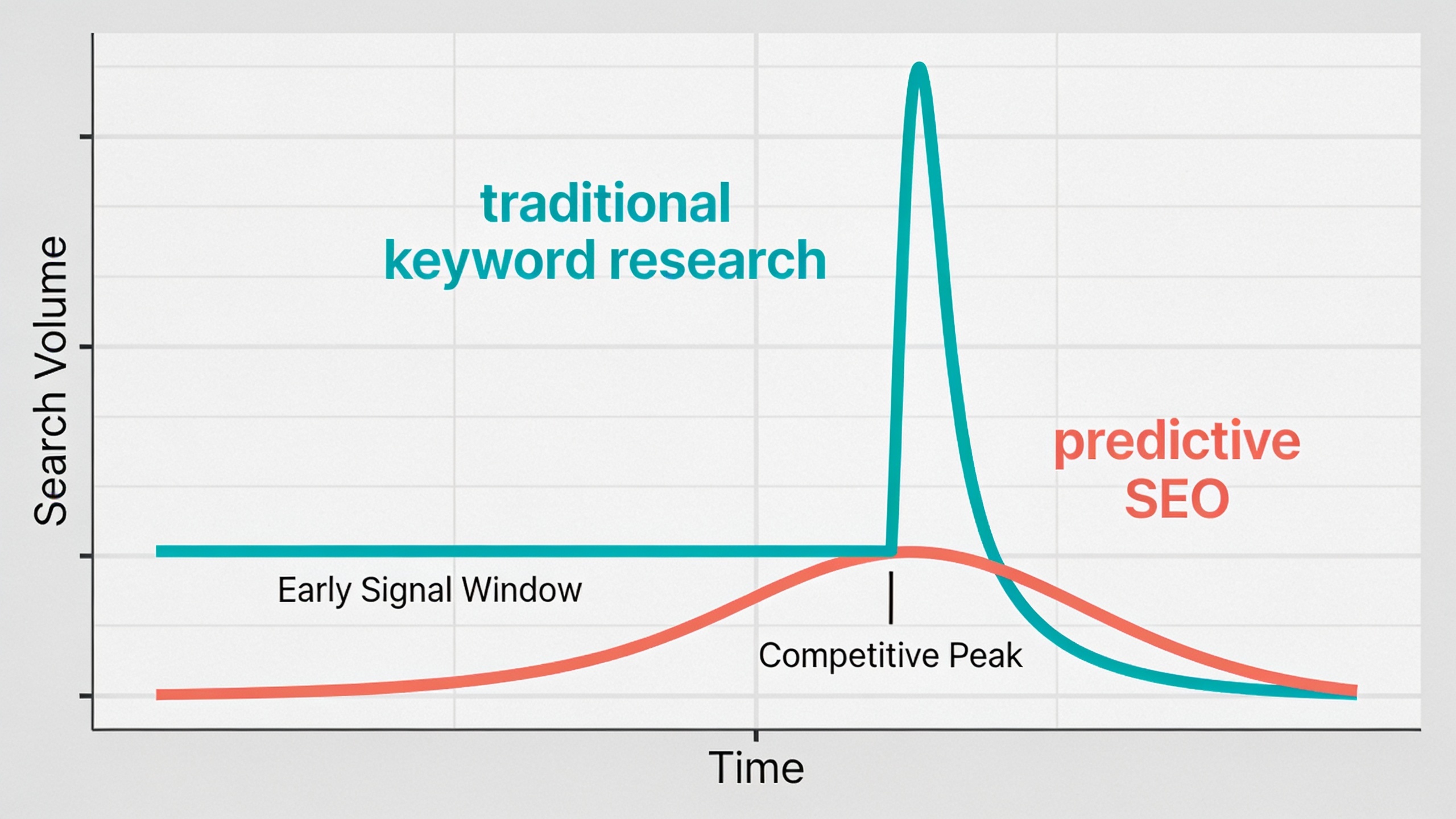
Predictive SEO is a forward-looking approach to search that uses machine learning to catch early demand signals for a topic before it turns into a competitive keyword. The difference from regular keyword research really comes down to timing. Traditional research tells you what people are already searching in bulk. Predictive SEO tries to tell you what they're about to search.
The idea isn't new, honestly. It's borrowed straight from demand forecasting in retail and finance, where the smart money watches leading indicators (those little upticks that reliably come before the big move) instead of waiting until the trend is obvious in the headline numbers. In search, a leading indicator might be a slow, steady climb in some niche query. Or a cluster of related questions popping up across forums and social. Or a sudden burst of "how to" phrasing around a product category the big publishers haven't touched yet.
The point isn't to guess and hope. It's to spot genuinely meaningful movement early enough that you can research, write, and ship something authoritative before a few dozen competitors do the exact same thing. And with AI Overviews and answer engines increasingly rewarding whoever covered a topic first and most thoroughly, that early window is worth more than it used to be.
How Does Predictive SEO Actually Work?
It works by feeding historical and real-time search data into models trained to recognize the early shape of a rising trend, then flagging topics whose current curve looks like the early stage of past breakouts. Nobody's reading minds here. It's pattern matching, just at a scale no human analyst could pull off by hand.
Pattern recognition, not prophecy
Most forecasting models are hunting for a few repeatable signatures. There's velocity, meaning how fast interest is accelerating relative to its own baseline (not just how big the number is right now). There's breadth, which is whether the interest is spreading across a bunch of related queries and subtopics instead of just one, because that usually signals a real shift rather than a one-off blip. There's cross-platform correlation, where a rise on social or in video search shows up mirrored in early web search movement, hinting the trend is actually migrating. And there's seasonality adjustment, which is just the boring but necessary work of telling a genuine emerging trend apart from something that repeats every single year like clockwork.
Train a model on years of query data and it learns what the "ramp" tends to look like in the weeks before a topic goes broadly competitive. When a new topic starts tracing a similar curve, it gets surfaced as a candidate worth a look. Not a guarantee. A probability-weighted nudge.
Why timing is the whole point
The entire value here rides on lead time. If a model only confirms a trend once it's already glowing red in your standard volume tools, it hasn't predicted anything. It's just reported the news a bit faster. The models that actually earn their keep are the ones flagging movement while volume is still low and difficulty scores haven't caught up yet, because that's the narrow window where a smaller site can realistically fight for the top spot and win.
The Data Sources Behind Search Trend Forecasting
Search trend forecasting is only as good as the data you pour into it, and the strongest models pull from several different sources instead of leaning on one. At its core, this is about analyzing patterns across query volume, related searches, and behavioral signals over time to catch momentum before it peaks.
The most common public starting point is Google Trends, which shows relative search interest over time and by region. Most analysts start there to get a feel for directional movement. But if you want a sharper read, you're going to want more than that.
Your own Search Console data is underrated for this. A topic gaining traction with your existing audience often shows up in your impression and click trends before any third-party tool notices. Autocomplete and "people also ask" boxes are worth watching too, since shifts in suggested query phrasing tend to run ahead of broader volume increases. And then there's social listening, which I'd argue is the most valuable of all for consumer stuff. Discussion volume on forums, video comment sections, and social platforms frequently moves before search engines fully register anything, especially for products, entertainment, and consumer tech.
Video search behavior deserves its own mention because it can lead traditional web search by weeks. That's a big reason marketers who want an early read on emerging interest keep an eye on how content performs on video platforms. Getting your head around how to optimize YouTube videos so they show up in search can double as a trend-detection move, since video search demand often hints at where web search is headed next. Oh, and news monitoring matters too. A topic showing up all over news aggregators without much search volume yet is a classic early-stage candidate.
No single source tells the whole story, though. The real advantage of an AI-driven setup is weighting and correlating all these streams at once, which would take a human analyst forever and with way less consistency.
From Signal to Strategy: Turning Predictions Into Content
A predicted trend is worth exactly nothing until it becomes published, well-optimized content. The forecasting step means nothing without fast, accurate execution behind it. And this is precisely where a lot of predictive SEO efforts quietly die. The team catches the signal, then burns three weeks in editorial review while the topic gets competitive anyway. Classic.
Speed without sacrificing accuracy
Here's the trap. The rush to publish on an emerging topic creates real risk, because content produced under time pressure (especially stuff drafted with generative AI) is more prone to factual errors and confident-sounding claims that are just plain wrong. Before you publish anything off a fast-moving trend, it's genuinely worth understanding how to catch AI content hallucinations before they wreck your SEO. A made-up statistic or an invented source in a rushed article can hurt your credibility far more than missing the trend window ever would.
What a workable pipeline looks like
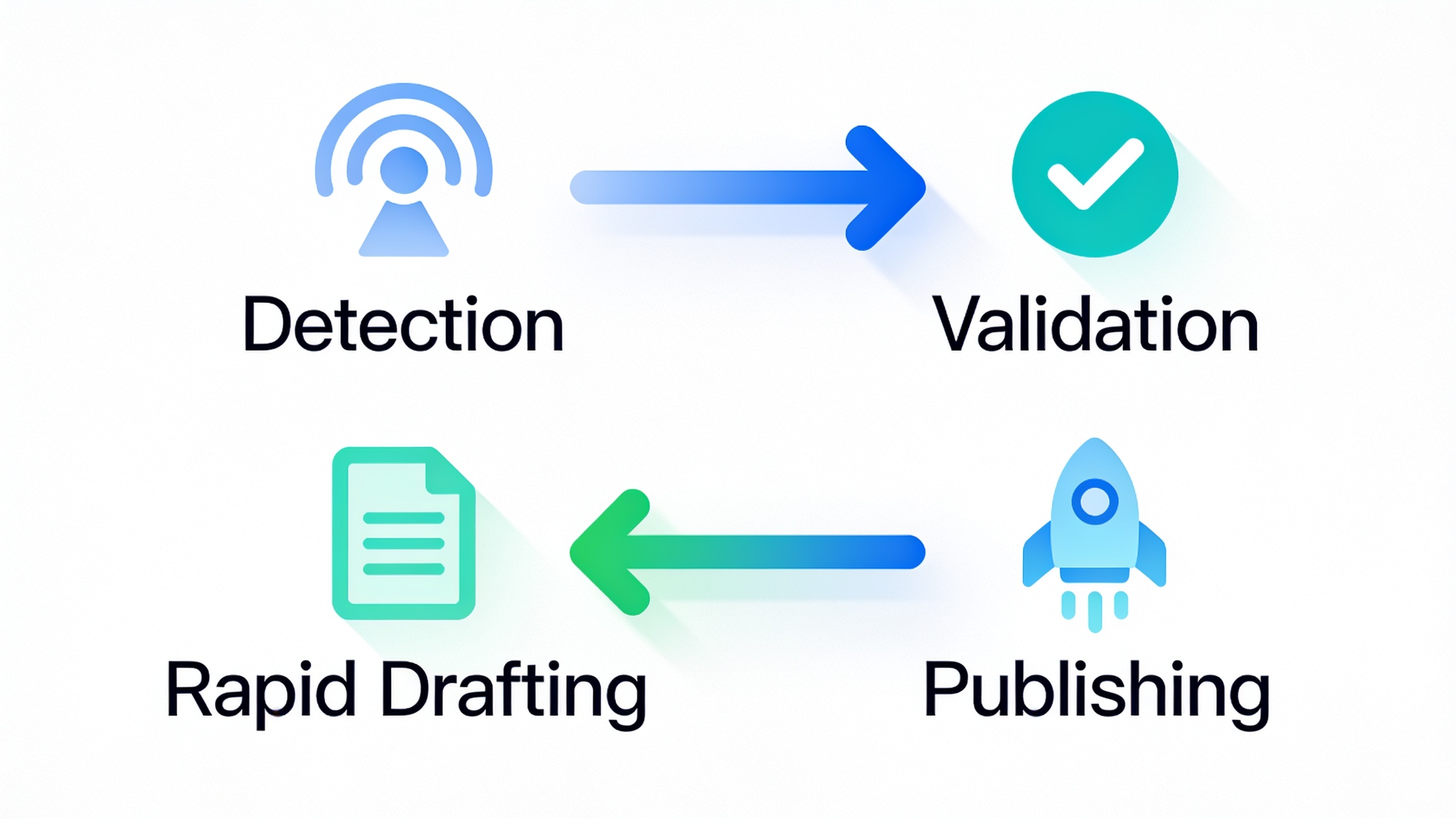
A practical pipeline for turning a prediction into a ranked page usually runs through four stages:
- Detection — a model or analyst flags an emerging query cluster based on early velocity and breadth.
- Validation — a human confirms the signal reflects genuine, lasting interest and isn't just a one-day news spike.
- Rapid drafting — content gets produced quickly, often with AI help, built around the specific questions people are starting to ask.
- Fact and source review — every claim, stat, and named entity gets verified against real sources before it goes live.
Want content like this running on autopilot for your own site? Try RobinRank free — AI-written, SEO-optimized articles generated and published automatically, no credit card required.
Skipping step four to save a day is the single most common way this whole approach backfires. A wrong fact published fast is worse for your rankings and your trust than a right fact published a few days late. Every time.
Predictive SEO vs. Traditional Keyword Research
These two aren't rivals. They answer different questions and honestly work best as a pair. Traditional keyword research tells you what has proven demand right now. Predictive SEO tells you where demand is probably heading next.
| Dimension | Traditional Keyword Research | Predictive SEO |
|---|---|---|
| Primary data | Historical search volume, keyword difficulty scores | Velocity, breadth, and cross-platform correlation over time |
| Best used for | Topics with proven, stable demand | Emerging topics with low current volume but rising momentum |
| Competition level when acting on it | Usually already established, higher difficulty | Typically lower, since competitors haven't caught up yet |
| Risk profile | Lower risk, but opportunity may already be crowded | Higher risk, since not every early signal turns into a real trend |
| Typical tools | Keyword research platforms, search volume databases | Trend-analysis tools, Google Trends, social listening, AI pattern models |
| Time-to-publish pressure | Moderate — content can be planned methodically | High — value depends on publishing before the topic saturates |
In practice, the strongest strategies use predictive signals to decide what to write next, then lean on traditional keyword data to nail how to structure and optimize it once the demand looks real and durable. Use both. Don't pick a side.
What Are the Limits and Risks of Predictive SEO?
Let's be clear: predictive SEO is probabilistic, not deterministic. It improves your odds of catching a trend early. It does not guarantee every flagged topic will take off. Treating every model signal as a sure thing is the fastest way I know to torch your editorial budget on topics that never turn into anything.
False positives are common
Search behavior is noisy as hell. A short-lived news event, one viral post, a seasonal blip. Any of these can briefly mimic the shape of an early-stage trend and then evaporate within a week. Models that aren't tuned carefully, or that just don't have enough historical data for your particular niche, will keep flagging topics that fizzle. That's exactly why a human who actually knows the industry needs to stay in the loop. This isn't a step you want to fully automate away.
Forecasting works better in some niches than others
Fast-moving consumer stuff (tech, entertainment, health trends, consumer products) tends to throw off cleaner, more forecastable signals because there's more historical precedent to learn from. Highly specialized B2B or regulatory topics move slower and lumpier, which makes pattern-based forecasting a lot shakier. If you're in a narrow niche market, don't expect the same accuracy a consumer tech blog might be getting. You'll just be disappointed.
Speed can compromise quality if you let it
Like I said earlier, the pressure to be first pushes teams to ship stuff that hasn't been properly checked. And here's a distinction people constantly blur: a model that's brilliant at predicting what will trend is not automatically good at writing accurate content about it. Those are two completely separate skills, and mixing them up is one of the bigger mistakes I see with teams new to these tools.
How to Build a Predictive SEO Workflow
Building a predictive SEO workflow means stitching together three things into one repeatable system: a trend-detection layer, a human validation step, and a publishing process that's fast but still accurate. No single tool does all three well, so stop looking for the magic button. Most small teams don't need an enterprise data science operation to get going either. What they need is discipline and a decent tool stack.
Step 1: Set up ongoing monitoring
Start with the free stuff. Google Trends for directional movement in your industry, plus regular checks of autocomplete and "people also ask" boxes for your core subjects. If your audience lives on video, watch video platform search behavior too, since it so often leads web search demand.
Step 2: Establish a validation checklist
Before you throw writing resources at a predicted trend, confirm two things. That the signal has breadth (multiple related queries rising together, not one lonely term). And that it isn't chained to a single news event with no lasting relevance to your people.
Step 3: Shorten the path from idea to published page
Once a topic's validated, the bottleneck is basically always production speed. This is where AI-assisted content platforms actually earn their money. RobinRank, for instance, has an Autopilot feature that automatically writes, optimizes, and publishes articles, which can seriously compress the gap between spotting an emerging topic and having a live, optimized page going after it. On RobinRank's Pro plan, Autopilot runs on one site alongside AI-generated articles and access to the community backlink network. It's aimed squarely at businesses that want to move on a trend without staffing up a full content team.
Step 4: Build authority signals alongside the content
Publishing early helps, but authority signals still decide how fast that content actually climbs. Which is where backlinks come in. RobinRank's core product is a manually reviewed backlink exchange network. Members browse a directory of vetted sites filtered by niche and Domain Rating, request a placement, offer a reciprocal link back, and then the platform verifies the live placement on both ends by crawling the page and confirming the link, and keeps checking it weekly after that. Because every site gets reviewed by hand (checked for an ownable domain, real content, and no spammy nonsense like private blog networks), the exchange dodges the throwaway placements that carry more risk than benefit. For a piece built around a freshly predicted trend, having a fast and legitimate way to build a few relevant links can help it establish authority before slower competitors' pages catch up.
Step 5: Review before you publish, every time
I don't care how fast your pipeline moves. A final fact and accuracy check happens before anything goes live, full stop. That goes double for AI-assisted drafts on a topic the writer doesn't have deep prior expertise in.
Frequently Asked Questions
Isn't this just trend-jacking with extra steps?
Nope. Trend-jacking usually means reacting to something that's already visible and crowded, chasing quick traffic with thin content. Predictive SEO is about spotting a trend before most competitors even see it, which buys you time to publish thorough, well-researched stuff while competition is still low.
Can a small business actually do this, or is it a big-company thing?
Small businesses can absolutely play, just with lighter tools than an enterprise data team would use. Free options like Google Trends, autocomplete monitoring, and social listening give you meaningful early signals, and pairing that with an AI content platform that publishes fast closes the resource gap a lot more than you'd think.
How early can AI models actually catch a trend before it peaks?
It really depends on your niche and how much historical data exists for similar past trends. Fast-moving consumer categories like tech and entertainment throw off clearer early signals than slow, specialized B2B topics. There's no universal lead time that holds across every industry, so be skeptical of anyone who promises one.
What's the biggest mistake teams make with predictive SEO?
Two, really. Publishing on every flagged signal without checking whether the trend has real breadth and staying power. And rushing content out so fast that accuracy takes a hit. Again: a wrong claim published quickly does more damage than a correct one published a few days later.
Does predictive SEO replace traditional keyword research?
No. They work together. Predictive signals help you decide what to cover next while it's still low-competition, and traditional keyword data helps you confirm intent and structure once there's evidence the demand is real and sustained.
Predictive SEO isn't a substitute for solid content fundamentals. It's a way to aim those fundamentals at the right topic before everyone else piles in. The teams that get the most out of it are the ones that combine real early-signal detection with honest validation, fast-but-accurate production, and the authority-building grind that helps new content climb once it's finally live.
Ready to stop writing content by hand? Start your free RobinRank trial and get a full month of SEO-optimized articles published on autopilot.