RobinRank vs SurferSEO: Which AI SEO Platform Actually Fits Your Team (And Where Does Content at Scale Land)?
One thing up front. This is a comparison, not a sales pitch dressed up as one. So I'll be straight about what's actually confirmed for each tool and what isn't. Where a detail hasn't been independently verified, I'll just say so instead of pretending I know.
Table of Contents
- What Problem Does Each Platform Actually Solve?
- RobinRank vs SurferSEO: Optimization vs. Real Link Building
- RobinRank vs Content at Scale: Where the Automation Stops
- What Do They Cost?
- The Whole Comparison in One Table
- Which Team Fits Which Tool?
- Getting Actual Value Out of Any of These
- FAQ
What Problem Does Each Platform Actually Solve?
All three tools live in the same neighborhood (AI-assisted SEO software), but they were each built to fix a different core headache: link building and content ops, optimization scoring, and high-volume article generation.
Let's take them one at a time.
RobinRank is built around two things that talk to each other. First, it writes and publishes optimized articles for businesses. Second, it runs a manually reviewed backlink exchange network where site owners actually request and offer real placements to each other. Per RobinRank's own site, every listing in its "Discover" directory gets reviewed by a human, needs a minimum Domain Rating of 5 or higher (measured via Ahrefs), and kicks out PBNs, link farms, and adult or spam niches. The framing they use is telling: it's less a marketplace where you buy links and more a network where "members give and get verified backlinks."
SurferSEO is the tool most people in SEO know as the one that dissects top-ranking pages for a keyword and spits out a scoring framework. Term usage, structure, length, that kind of thing, all meant to nudge a writer toward a draft that can actually compete. I'll be honest here: the current feature lists and pricing tiers for SurferSEO weren't part of the source material I had for this piece, so if you're seriously evaluating it, go check their own site for the latest before you commit to anything.
Content at Scale has a reputation as the AI long-form machine. The pitch is basically: publish more articles than a normal in-house team could ever write by hand. Same caveat as above though. The granular stuff (current features, pricing, workflow) wasn't in my source material, so treat whatever you read elsewhere as something to verify yourself.
Here's how I'd sum it up. If your bottleneck is "we don't have enough backlinks or enough hands writing," RobinRank's write-and-link combo tackles both at once. If your bottleneck is strictly "our drafts aren't sharp enough to crack page one," then a scoring tool like SurferSEO is aimed at that narrower job. And if your bottleneck is just raw output, Content at Scale is built for exactly that pain.
RobinRank vs SurferSEO: Optimization vs. Real Link Building
The big split between RobinRank and SurferSEO is simple: SurferSEO is an on-page optimization layer you apply to content, while RobinRank pairs content publishing with an actual way to go get backlinks. On-page tools don't touch that second part at all.
And that matters more than people admit. On-page optimization is great, but it only solves half the ranking puzzle. Google has always weighed both content relevance and off-page signals like backlinks. A gorgeously optimized page with zero external authority still tends to get smoked by a scrappier page sitting on a stronger link profile. That's exactly the gap RobinRank's exchange is aimed at, especially for teams who've already got their content structure figured out but have no reliable way to earn links.
So how does the actual exchange work? Per RobinRank's own description, a member browses Discover (filtered by niche, language, and Domain Rating), fires off a request for a placement that names the target page and the anchor text, and can optionally offer a reciprocal link back. The site owner on the other side replies in a chat thread, they accept, decline, or haggle over which page. RobinRank then says it crawls the live page afterward to confirm the href actually exists before it counts the placement as verified.
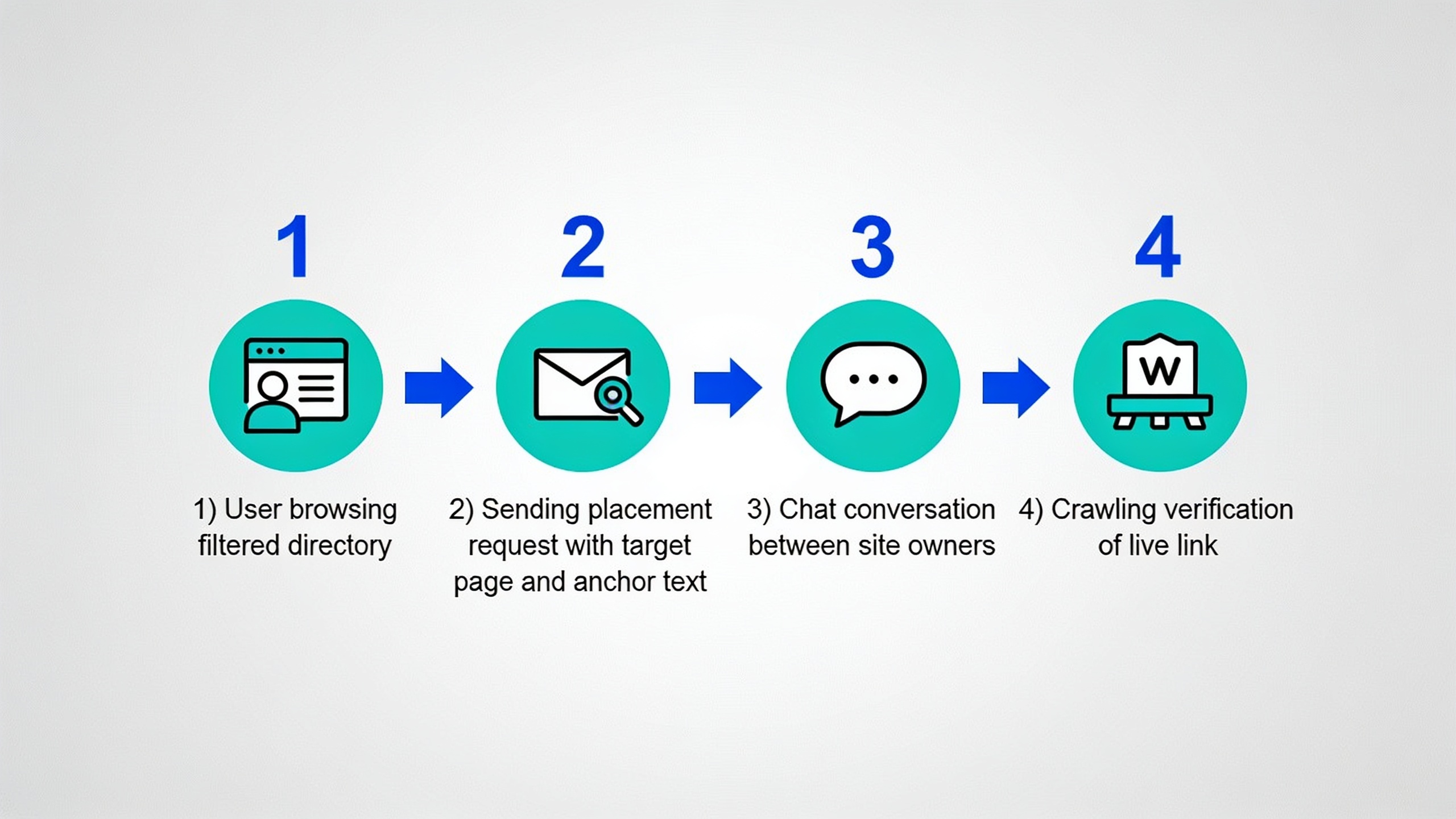
Two numbers they report are worth chewing on: 65% of requests get answered within seven days, and roughly 30% actually end up published on a live page. That gap between "someone replied" and "there's a real link" is the honest part of outreach nobody talks about. A reply isn't a link. And I'll give RobinRank credit for being upfront that a placement only counts once the href is genuinely crawlable.
SurferSEO, meanwhile, has built its whole reputation on the scoring and drafting side. It helps a writer see what a top-ranking page structurally contains so a new draft can go after the same query. Based on what's out there, it doesn't offer anything like a link-acquisition mechanism. That's just not in its lane as an optimization tool. So teams needing both functions usually end up duct-taping an optimization tool to a separate outreach process, which is the exact stitching RobinRank is trying to eliminate with one subscription.
Oh, and one more thing. If your content process is already solid and you just want links, don't overlook what's already on your own site. Pairing any link-building push with a deliberate internal linking strategy tends to multiply the value of every new external link you land, since internal links spread that authority around your site instead of letting it puddle on a single landing page.
RobinRank vs Content at Scale: Where the Automation Stops
The meaningful difference between RobinRank and Content at Scale is what happens after the draft is written. Content at Scale is generally positioned around the generation itself, while RobinRank's stated model pushes automation into publishing and, separately, into backlink acquisition through its verified exchange.
I keep coming back to this idea of "automation depth" because "AI SEO platform" can mean wildly different things depending on where the robot hands off to a human. Some tools automate the first draft and dump optimization, publishing, and promotion back on you. Others automate the writing and the optimization but leave distribution entirely up to you. RobinRank's materials say the automation reaches into the outreach side too. The platform drafts outreach messages for members using the exchange, but leaves the final call about who to link to (and where) with the site owner. Their exact words: "Outreach drafted for you and every placement checked on the live page. You still decide who to link and where."
That last bit is the part I'd care about most if I'd been burned before. RobinRank frames itself as automating the boring, repetitive stuff (drafting messages, crawling pages to verify placements, running weekly checks) while keeping a human veto right at the moment a link actually goes live. I can't do a clean feature-by-feature against Content at Scale here because its workflow controls weren't confirmed in my source material. But it's a fair question to put to any AI content vendor: at what point does a human get to say no, and what fires off automatically no matter what?
For teams still nursing scars from cheap, low-effort AI content, that governance question usually beats raw output speed every time. A consistent brief helps here regardless of the tool, which is why a lot of teams bolt their AI drafting onto something like a content brief template to keep tone, structure, and depth steady even as the volume climbs.
What Do They Cost?
RobinRank's pricing, per its own site, is a free 7-day trial after your site passes manual review (no card needed), then a flat $19 a month, cancel whenever. The whole philosophy leans on low commitment plus a quality gate, rather than locking features behind a ladder of tiers. Verified public pricing for SurferSEO and Content at Scale wasn't in my source material, so I'm not going to guess at their current plans. Check each vendor's pricing page before you build a budget around anything.
Want content like this running on autopilot for your own site? Try RobinRank free — AI-written, SEO-optimized articles generated and published automatically, no credit card required.
What I can compare is the pricing philosophy, since that's the part each vendor's public messaging actually gives away.
RobinRank ties onboarding to a quality gate: you pass a manual site review before you're even allowed into the Discover network, and then you pay one flat monthly rate instead of climbing tiers. The only tier split mentioned publicly is a "Pro" level that adds ongoing automatic checks confirming a placed backlink is still live, with alerts if it vanishes.
SurferSEO and Content at Scale are both broadly understood to run the tiered SaaS pricing that's standard for content and SEO software (higher tiers unlocking more words, seats, or projects), but the actual tier names, limits, and prices weren't confirmed in what I had.
So the practical read: if your team likes predictable, flat costs no matter how many placements or articles you're juggling, RobinRank's $19-a-month-after-trial thing is dead easy to budget. But if your usage swings hard month to month (a big Q1 content sprint, a sleepy Q3), a tiered structure elsewhere might flex better for you. You'd just have to confirm the actual tier mechanics with those vendors yourself.
The Whole Comparison in One Table
This sums up what's publicly confirmed for each platform based on the source material I had. Cells marked "Not stated" mean there's a real information gap, not that the product is weak in that area. I'd rather flag the hole than fill it with a guess.
| Dimension | RobinRank | SurferSEO | Content at Scale |
|---|---|---|---|
| Core focus | AI article writing/publishing + verified backlink exchange | Content optimization/scoring against SERP data | AI-generated long-form content at volume |
| Backlink building | Yes — manually reviewed exchange network, DR 5+ minimum (Ahrefs) | Not stated publicly | Not stated publicly |
| Link verification | Crawls live page to confirm href; Pro tier adds ongoing checks | Not stated publicly | Not stated publicly |
| Onboarding gate | Manual human review of each site before joining Discover | Not stated publicly | Not stated publicly |
| Pricing model | Free 7-day trial after approval, then $19/month flat, cancel anytime | Not stated publicly (industry-typical tiered SaaS pricing generally expected) | Not stated publicly |
| Outreach automation | AI drafts outreach messages; human approves final placement | Not stated publicly | Not stated publicly |
| Reported engagement rates | 65% of requests answered within 7 days; ~30% result in a published live link | Not stated publicly | Not stated publicly |
| Site quality restrictions | No PBNs, farms, adult/spam niches, no free hosting platforms | Not stated publicly | Not stated publicly |
Which Team Fits Which Tool?
The right platform depends way less on your team size and way more on whether your bottleneck is optimization, link acquisition, or raw volume. RobinRank's combined model tends to suit teams that just don't want to run two separate tools for writing and linking.
Solo consultants and freelancers bouncing between client sites usually can't afford hours of manual cold outreach per client. RobinRank's Discover browsing plus the chat-based request system (filtered by niche and Domain Rating) is designed to swap the outreach-list grind for direct conversations that either land or don't inside a defined window. RobinRank pegs that at 65% answered within seven days.
In-house content marketers at startups and small businesses are almost always short on headcount and need a tool that automates as much of the writing-to-publishing pipeline as it can without stripping away editorial control. RobinRank's broader platform, per its own description, writes, optimizes, and publishes articles while keeping backlink decisions in human hands. Which spares you the pain of maintaining a separate optimization subscription plus a separate outreach service.
Agencies running lots of client sites tend to love flat, predictable per-site costs over usage-based billing that spikes when you least expect it. RobinRank's flat $19/month (after the trial) is simple to model across a client roster, though I'd nudge any agency to ask whether volume or multi-site discounts exist beyond what's stated publicly.
Teams laser-focused on on-page scoring against competitor pages, with their content creation and link building already handled elsewhere, are the clearest fit for a dedicated optimization tool like SurferSEO. Assuming its current feature set (which I couldn't independently confirm here) actually matches that narrow need.
And teams whose one real constraint is publishing volume, who've already nailed optimization and links some other way, are the crowd Content at Scale is generally understood to court. Again though, confirm the fit against its current public features rather than my assumptions.
Getting Actual Value Out of Any of These
No AI SEO tool, not RobinRank, not SurferSEO, not Content at Scale, replaces a documented editorial process. It accelerates one you already have. The teams that get the best results pair whatever they pick with two habits that are completely tool-agnostic: consistent briefing and deliberate internal linking.
On briefing: AI drafting tools give you far more consistent output when you feed them a consistent brief every single time, instead of one-off prompts that shift by writer or by week. That's the whole point of a repeatable content brief template, which keeps tone, depth, and structure aligned as your blog scales from a handful of posts a month to dozens.
On linking: every backlink you earn (through a reviewed exchange like RobinRank's or any other legit method) performs better when the destination page is well connected internally. A page that catches an external link but sits orphaned on your site, with no internal links pointing to or from it, throws away most of that authority. A real internal linking strategy makes sure that link equity actually flows to the pages you most want ranking, instead of dead-ending on one lonely article.
FAQ
So is RobinRank a backlink service, a content platform, or what?
Both, actually. Per RobinRank's own site, it writes, optimizes, and publishes articles, and separately runs a manually reviewed backlink exchange where members request and offer placements directly with other site owners. It calls itself an exchange network, not a paid link marketplace.
Does RobinRank promise me a set number of backlinks each month?
No, the public materials don't state a guaranteed count. What they do report is engagement: 65% of placement requests get a reply within seven days, and about 30% turn into a link that's actually published and crawl-verified on a live page. That framing tells you results hinge on member activity in the network, not a fixed quota.
How does RobinRank actually check that a backlink is real and still up?
It says it crawls the destination page to confirm the href exists before counting a placement as verified. The Pro tier layers on ongoing automatic checks that alert you if a link you placed earlier disappears.
Do I need my own domain to join the exchange?
Yep. RobinRank's site specifies you need an "ownable domain," which rules out free hosting platforms and public site builders, plus a minimum Domain Rating of 5 or higher (via Ahrefs) before your site can join Discover.
Which one's cheapest: RobinRank, SurferSEO, or Content at Scale?
RobinRank publicly states a free 7-day trial (no card) then a flat $19 a month, cancel anytime. Current pricing for SurferSEO and Content at Scale wasn't confirmed in my source material, so hit each vendor's own site for the latest before you compare costs head to head.
So Where Does This Leave You?
There's no universal winner here, only a better fit for whatever your team is actually missing. If your gap is a lack of verified, human-negotiated backlinks alongside AI-assisted writing and publishing, RobinRank's combined model and flat $19/month (after that free trial) is genuinely worth testing against your current workflow. If your gap is purely on-page optimization or purely content volume, go confirm SurferSEO's and Content at Scale's current features and pricing on their own sites, since those specifics weren't in the material I reviewed. Whatever you land on, wrap it in a consistent briefing process and a deliberate internal linking habit. The software speeds up the work, sure. But the editorial discipline around it is still what decides whether any of it actually ranks.
Ready to stop writing content by hand? Start your free RobinRank trial and get a full month of SEO-optimized articles published on autopilot.