SERP Volatility: What to Actually Do When Google Rankings Start Bouncing Around

Table of Contents
- What Is SERP Volatility?
- What Causes Google Ranking Fluctuations?
- Is This SERP Volatility a Real Update or Just Noise?
- Recent SERP Volatility Trends Marketers Should Know
- Types of Ranking Swings and How to Respond
- What Should Marketers Do When Rankings Swing?
- Building an SEO Strategy That Survives Volatility
- FAQ: SERP Volatility and Ranking Fluctuations
What Is SERP Volatility?
SERP volatility is basically how much search rankings move across a batch of keywords over a set period, usually measured day to day or week to week. Rank-tracking tools spit it out as a relative score rather than a hard number, so a higher score just means more positions got reshuffled compared to a calm baseline. Low volatility? Most sites are sitting tight. High volatility? Lots of pages are moving up and down at once, often across industries that have nothing to do with each other.
Now, one thing worth getting straight early. SERP volatility is a market-wide thing. It's different from your one site's ranking dipping, which might have a boring, specific cause like a broken link or a competitor publishing something better. When volatility spikes across tons of sites and niches all at the same time, that's usually Google shipping something. When it's just you moving while your competitors don't budge? That's almost always a local problem: a technical hiccup, a content edit, a link that got added or dropped.
What Causes Google Ranking Fluctuations?
Ranking fluctuations come from a mix of confirmed algorithm updates, routine index refreshes, personalization, and Google constantly poking at things. And it pokes a lot. According to Google's own "How Search Works" transparency report, the company runs hundreds of thousands of search experiments a year that end up producing thousands of live changes to ranking. Most of them are so tiny you'd never notice. A few of them, the broad core updates, are big enough to move rankings all over the web.
The Big Confirmed Updates
Every so often Google announces a "broad core update" through its Search Central account on X and its blog. These are large-scale tweaks to the core ranking systems, and they can hit a meaningful chunk of queries worldwide. In 2024 alone, Google confirmed core updates in March, August, November, and December, plus a handful of spam updates aimed at things like scaled content abuse and site reputation abuse. The March 2024 core update was a real slog, taking over a month to fully roll out. That drawn-out timeline is exactly why people saw weeks of visible chaos, since different data centers updated on their own schedules.
Personalization and Where You're Sitting
Here's something people forget: search results are never truly identical for two people. Your location, your search history, your device, even which specific Google data center answers your query, all of it can nudge rankings for the same keyword at the same moment. So when your rank tracker swears you're in position 4 and a real searcher sees you at 6, they're not necessarily wrong. They're just seeing a different slice of reality.
SERP Feature Changes
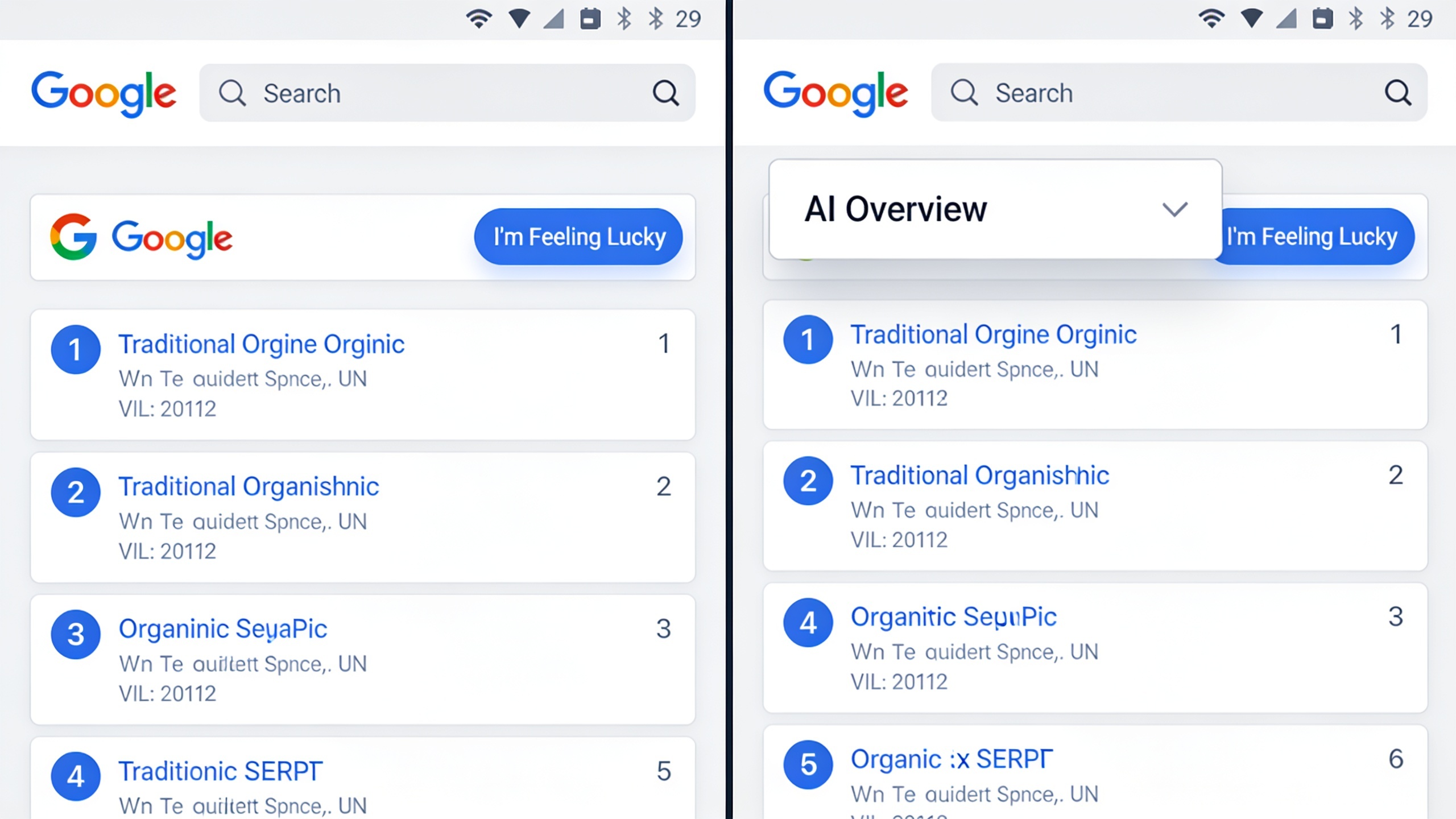
When Google adds or yanks a SERP feature, a featured snippet, a "People Also Ask" box, an AI Overview, your organic listing shifts even though its actual ranking hasn't moved an inch. The AI Overviews rollout in the US, announced at Google I/O in May 2024, is the textbook example. Pages that used to sit comfortably at position 1 or 2 suddenly looked lower on the page because there's now an AI-generated answer box hogging the space above them. If your tracker only measures blue-link position, it'll flag this as a "drop" even though the page's authority never changed. Annoying, right?
Testing and A/B Buckets
Google routinely tests ranking changes on a slice of users before rolling anything out widely. If your rank tracker happens to be querying from a location or device profile that got caught in a test bucket, you'll see a swing that just... reverts once the test wraps. Most real searchers never saw a thing.
Crawling and Indexing Lag
And sometimes rankings wobble simply because Google hasn't finished recrawling your page yet. A fresh article, an updated title tag, a new batch of backlinks, all of it can take days or weeks to fully register. What looks like random movement is often just Google catching up to changes you already made.
Is This SERP Volatility a Real Update or Just Noise?
The fastest way to tell whether a ranking change is a genuine algorithm update or just noise is to check whether the movement is isolated to your site or showing up across a bunch of unrelated sites at once. If competitors in totally different niches are also reporting swings on the same day, that's a market-wide event, not something specific to you.
A few ways to actually confirm it. Start by cross-checking the industry volatility trackers. SEO communities lean hard on those third-party "SERP temperature" tools that aggregate movement across thousands of tracked keywords every day, and when a spike lines up with everyone freaking out in the forums on the same date, that's a pretty solid sign something real happened. Next, go straight to the source: Google's Search Status Dashboard and Search Central blog publicly confirm when broad core updates and spam updates start and end. If Google's said nothing and your tracker is the only one showing a spike, the cause is probably local, or your tool's sampling is being weird.
Also, don't treat any single tool's volatility score as gospel. Different tools track different keyword sets, locations, and devices, so if one screams "big swing" and two others say your positions are stable, put more weight on the boring local explanation. And finally, look at the trend over days, not hours. One day of movement is way more likely to be noise. A shift that holds for a week or more? That's probably a real ranking factor change.
Recent SERP Volatility Trends Marketers Should Know
SERP volatility has gotten louder and more frequent since 2023, mostly because Google's shipping ranking changes more often, and because generative AI features are literally reshaping what the results page looks like. If you're only tracking blue-link position without accounting for these bigger structural shifts, you're going to misread what's happening. Constantly.
Two things are piling up at the same time. First, Google's been leaning into frequent, chunky core updates plus dedicated spam updates targeting specific abuse patterns like scaled content churned out purely to game rankings, and expired-domain abuse. Second, AI Overviews have changed how much organic real estate is even visible above the fold. Which means a page can lose clicks and visible position without losing a shred of underlying ranking authority. This is exactly why treating rank position as your only metric is a trap. A fuller picture, impressions, click-through rate, converted traffic, tells a far more honest story. That's the kind of multi-metric view laid out in 10 SEO KPIs marketers should track every month, which is genuinely useful if your team is trying to work out whether a volatility event actually hit the business or just moved some cosmetic numbers around.
Types of Ranking Swings and How to Respond
Not every swing deserves the same reaction. Some are a shrug. Some are a fire drill. Here's a rundown of the common patterns, what usually causes them, and how to respond.
| Pattern Observed | Typical Duration | Likely Cause | Recommended Marketer Action |
|---|---|---|---|
| Single keyword moves 1–3 positions for a day | Hours to 1 day | Personalization, data center variance, tool sampling noise | Ignore; recheck in 48–72 hours |
| Many unrelated keywords move at once, across your site and competitors' | Days to weeks | Confirmed broad core update or spam update | Wait for rollout to complete; review content quality broadly, don't rewrite reactively |
| Only your site's rankings drop while competitors stay stable | Ongoing until fixed | Technical issue, lost backlinks, thin/duplicate content, manual action | Audit technical health, backlink profile, and recent content changes |
| Visible position drops but impressions/clicks stay flat | Ongoing | New SERP feature (AI Overview, featured snippet) pushing listings down visually | Track CTR and traffic, not just position; adjust content to target featured-snippet-style answers |
| Gradual, sustained decline over weeks | Weeks to months | Content decay, competitor improvement, changing search intent | Refresh and re-optimize content; reassess keyword targeting |
| Sharp overnight ranking loss across the entire site | Days to permanent | Technical outage, security issue, or manual/algorithmic penalty | Check Search Console for manual actions and crawl errors immediately |
Want content like this running on autopilot for your own site? Try RobinRank free — AI-written, SEO-optimized articles generated and published automatically, no credit card required.
What Should Marketers Do When Rankings Swing?
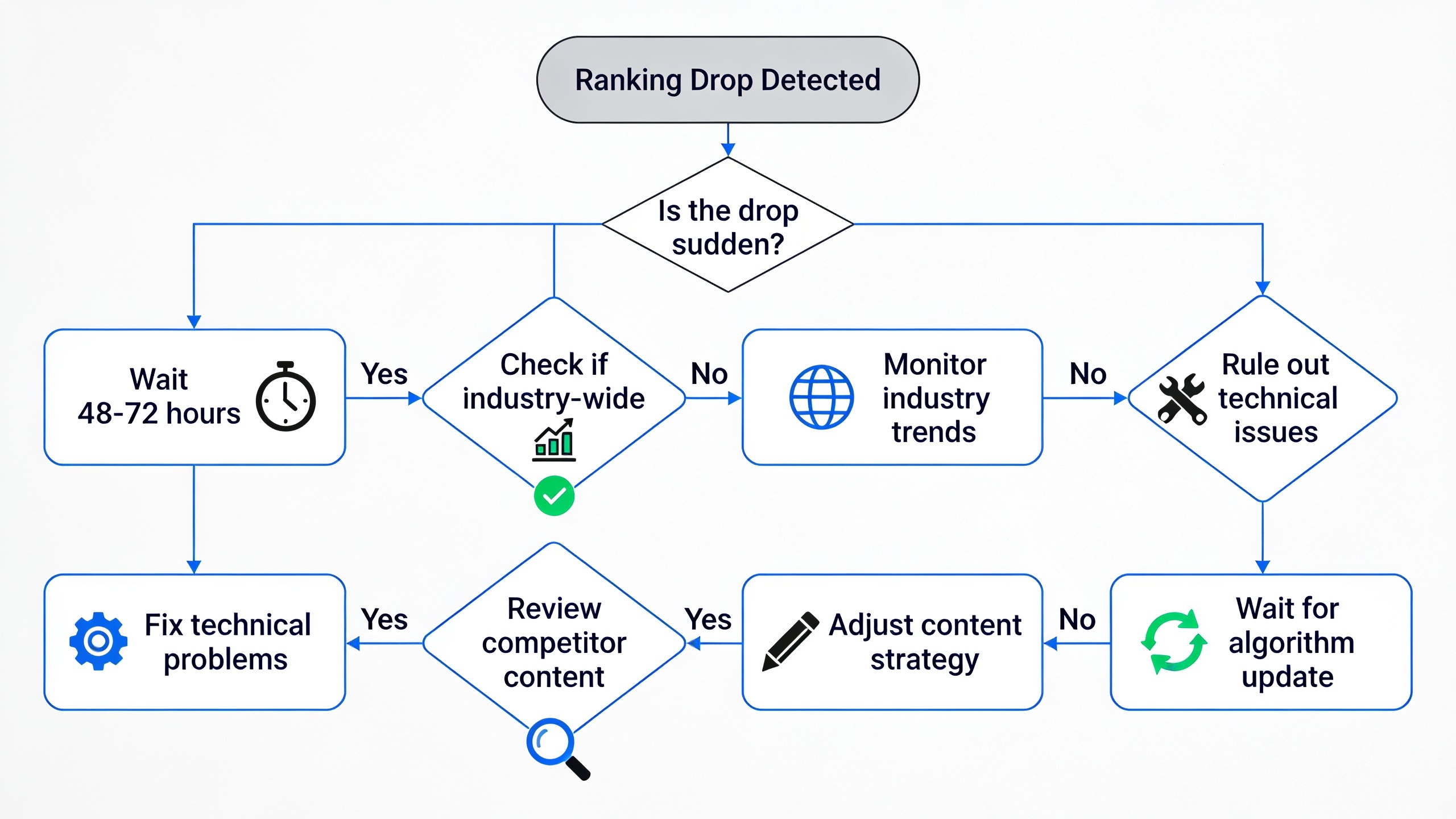
The single most important move is to wait and verify before you touch anything. I can't stress this enough. Reactive edits made in a panic usually cause more damage than the volatility ever would have. Since a huge chunk of day-to-day movement reverts on its own, rewriting titles or yanking pages within 24 hours of a dip is one of the most common ways people shoot themselves in the foot.
A calmer, more disciplined process goes something like this.
Give it time. Most short-term wobbles settle within a few days. And for confirmed broad core updates, Google itself has said rollouts can take anywhere from one to several weeks to finish, so judging a page's "final" position mid-rollout is jumping the gun.
Zoom out from individual keywords. One keyword's position is a noisy, jumpy signal. Look at the aggregate across a topic cluster, a content category, the whole site. If ten related keywords are all sliding together, okay, that's real. If one keyword out of fifty twitched? Noise.
Separate visibility from actual business impact. A ranking drop that doesn't cost you clicks, leads, or revenue is a cosmetic problem, not a real one. Flip side: a small dip on a high-intent, high-conversion keyword can matter way more than a dramatic swing on some low-value term nobody buys from. This is precisely why tracking a broader set of KPIs, impressions, CTR, conversion rate, revenue per organic session, alongside raw rank matters more during volatile stretches than at any other time.
Rule out the boring stuff first. Before you go blaming a mysterious algorithm shift, check for the unglamorous culprits: a broken canonical tag, an accidental noindex, a lost backlink, a competitor's shiny new article, or a manual action sitting in Google Search Console. Honestly, these are far more common causes of a single-site drop than some cryptic Google change.
Don't go on a panic content purge. After the helpful-content updates, a bunch of site owners rushed to delete pages by the hundreds based on a few days of signals. Deleting content wholesale is high-risk and really hard to walk back. If you're going to do it, base it on sustained data over weeks, not a Tuesday-to-Thursday scare.
And one habit that pays off enormously over time: keep a simple log. Track the confirmed update dates from Google's Search Central announcements right next to your own ranking, traffic, and conversion data. After a few update cycles, that log becomes one of the most useful diagnostic tools your team has, because it lets you tell the difference between "this always happens during core updates and recovers" and "this is new and it's not going away."
Building an SEO Strategy That Survives Volatility
Your best defense against volatility isn't reacting faster. It's building a foundation that doesn't hinge on any single ranking holding steady. Sites with a diversified, genuinely useful content footprint and a healthy, natural backlink profile tend to recover faster and swing less violently than sites built on thin pages or sketchy link tactics, which, not coincidentally, are exactly what Google's spam updates are built to hunt down.
On the content side, that means prioritizing pages that actually demonstrate expertise and answer what the searcher wants, instead of pages cynically engineered around a single keyword. On the link side, it means earning links from real, relevant sites rather than anything that leaves an obvious footprint. Understanding which link signals actually carry weight matters here too, because Google doesn't treat every link the same, and the difference between do-follow and no-follow links and what actually moves rankings is worth knowing before you sink time into any link-building push. Chase the wrong kind of link and you'll burn effort without building any real resilience.
For teams that want to lean less on manual outreach for both of these, RobinRank is built around two connected jobs. It uses AI to write, optimize, and publish articles automatically, and it runs a manually reviewed backlink exchange network where site owners request placements from each other directly instead of grinding through cold email. Every site in the network gets reviewed by hand, has to clear a minimum Domain Rating of 5 or higher (per Ahrefs), and every live placement gets crawled to confirm the link actually exists before it counts, with Pro-tier accounts getting ongoing automatic checks that a placed link hasn't quietly disappeared. None of this makes a site immune to SERP volatility, obviously, since no tool on earth controls Google's algorithm. But a steady drumbeat of quality content and verified, relevant backlinks is the kind of structural strength that holds up across update cycles far better than a site propped up on a handful of fragile pages.
FAQ: SERP Volatility and Ranking Fluctuations
How long does SERP volatility usually last after a Google update?
Depends on the update. Confirmed broad core updates have historically taken anywhere from about one to several weeks to fully roll out, based on Google's own announcements on its Search Status Dashboard, and you'll see movement continue for that whole rollout window. Smaller, unconfirmed wobbles tied to personalization or testing usually sort themselves out within a few days.
Should I change my content every time I see a ranking drop?
No. Please, no. Editing content the second you see a short-term dip is one of the most common overreactions in the whole field, because so much day-to-day movement reverts without you lifting a finger. Wait for a confirmed update to finish rolling out, check whether the drop is just you or everywhere, and only make changes once you've spotted a specific, sustained problem, like genuinely outdated info, thin coverage, or a competitor who just plain did it better.
How do I tell if a ranking change is Google's doing or my own site's?
Compare yourself against what's happening industry-wide. If competitors across unrelated niches are all seeing volatility on the same date and Google's Search Central channels have confirmed an update, it's external. If you're moving while your competitors sit still, hunt for site-specific causes first: technical errors, lost or added backlinks, recent content edits, or a manual action flagged in Search Console.
Does SERP volatility mean my SEO strategy has failed?
Not on its own. Volatility is just a normal, ongoing feature of how Google's ranking systems work. Some fluctuation is happening literally all the time, and bigger swings show up during confirmed core and spam updates. Judge your strategy on sustained trends over weeks and months, and on business metrics like organic conversions and revenue, not on where you sat for one bad Tuesday.
What should I watch instead of just keyword rank during volatile periods?
Impressions, click-through rate, converted organic sessions, and revenue per organic visit give you a much fuller picture than raw rank alone, especially now that SERP features like AI Overviews can shove your visible position around without touching your actual ranking authority. Tracking a fuller set of monthly SEO KPIs makes it a whole lot easier to tell a cosmetic dip from a real business problem.
Rankings are going to keep moving. That's just what a search engine running constant experiments and periodic big updates does. The marketers who come out ahead aren't the ones twitching at every daily swing. They're the ones who wait for confirmation, watch the metrics that actually reflect the business, and keep investing steadily in solid content and real backlink relationships that hold up no matter which way the SERP lurches next.
Ready to stop writing content by hand? Start your free RobinRank trial and get a full month of SEO-optimized articles published on autopilot.