The Founder's Guide to Ranking on Google Without a Marketing Team

So this is the other playbook. What to prioritize, what to hand off to software, where your limited hours actually pay off, and how to get backlinks without becoming a full-time cold-email robot. Written for people who need this to work, not people writing a thesis about it.
Table of Contents
- What Is SEO for Founders, and Why Is It Different From Agency SEO?
- Why Solo Founders Can't Just Copy the Big-Company SEO Playbook
- How Can Founders Rank Without a Marketing Team? An Automation-First Framework
- Content at Scale: Comparing Your Options as a Solo Founder
- Backlinks Without Cold Outreach: Earning Links as a Solo Founder
- On-Page and Technical SEO Basics You Genuinely Can't Skip
- SEO for Founders: What Does It Actually Cost in Time and Money?
- A Realistic 90-Day SEO Action Plan for Founders
What Is SEO for Founders, and Why Is It Different From Agency SEO?
SEO for founders is building organic search visibility as someone who isn't a marketer, working with barely any time and even less budget, usually without a content writer, an SEO strategist, or a link builder in sight. What makes it different from agency SEO isn't the tactics. It's the constraints, and the constraints run the show. You don't have six weeks to wait on a content calendar to get "approved." You're not paying a retainer for "strategy sessions." You need a lean system that quietly pumps out ranking pages and links while you're doing literally everything else.
Most SEO advice out there quietly assumes a team. Someone researches keywords, someone writes, someone edits, someone builds links, someone makes the pretty reports. Founder SEO smashes all five of those jobs into one person plus a stack of tools. That shifts a few things in ways that actually matter.
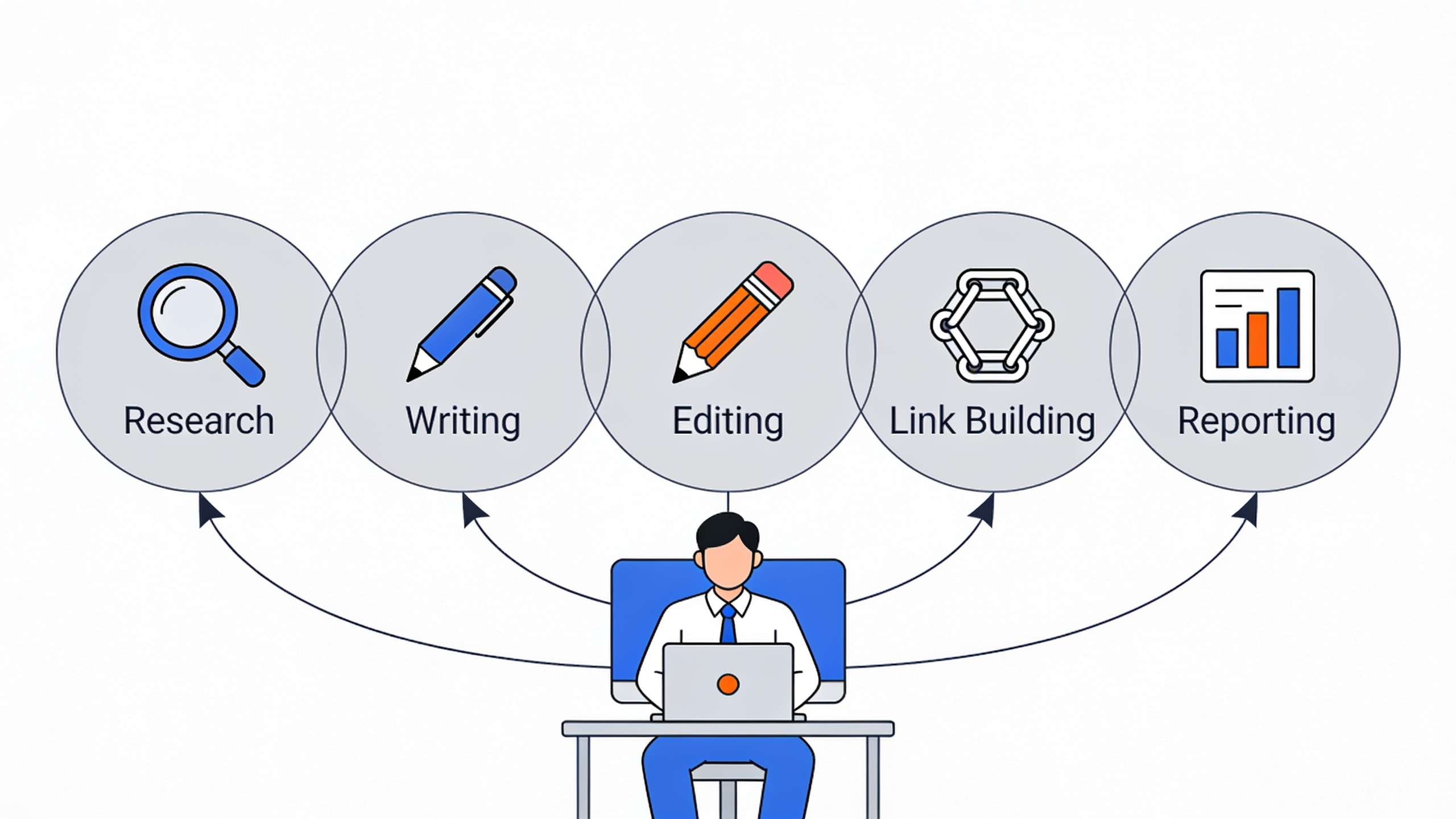
Your priorities move toward the high-leverage stuff, meaning solid technical foundations, a few genuinely good pillar pages, and durable backlinks, instead of cranking out a mountain of thin blog posts. Automation replaces delegation, so instead of tossing a task to some junior writer you don't have, you toss it to software. And consistency beats perfection every single time. A founder who publishes one solid article a week for six months will almost always smoke the one who dumps ten posts in a weekend and then vanishes for a quarter.
Why Solo Founders Can't Just Copy the Big-Company SEO Playbook
Big companies win at SEO through raw volume and years of accumulated domain authority, and neither of those is available to you when you're trying to launch a product this quarter. Copy that approach without the resources underneath it and you end up with a half-built content calendar and a backlink campaign you abandoned in week three. I've watched it happen. A lot.
Three things structurally break the copy-paste approach for solo founders, and they're worth naming.
First, time. You're doing sales calls, making product decisions, and answering support tickets, sometimes all before lunch. Marketing has to squeeze into the gaps, which means every SEO task needs to be either fast or automated. There's no third option.
Second, you don't have an editorial bench. Agencies and in-house teams have writers, editors, a whole review chain. You writing every article by hand hits a wall fast. Honestly, most people can't sustainably produce more than one or two well-researched, properly optimized articles a week while also, you know, running a company.
Third, you can't do outreach at scale. Backlinks are still one of the strongest ranking signals, but the classic version of link building, cold-emailing hundreds of site owners and praying for a couple of replies, is exactly the kind of high-effort, low-yield grind a time-starved founder can't keep up. This is where the tooling has genuinely moved on. Instead of mass emails, founders now lean on link exchange networks, digital PR moments, and content that just naturally pulls in citations.
How Can Founders Rank Without a Marketing Team? An Automation-First Framework
Founders can rank without a marketing team by swapping every labor-heavy SEO task (keyword research, writing, on-page optimization, publishing, link building) for a tool or system that does about 80% of it, then bringing founder judgment to the last 20%. You're not trying to remove humans from the loop. You're removing humans as the bottleneck. Big difference.
Here's how it actually shakes out.
Step 1: Pick a narrow keyword focus, not a broad content calendar
Forget covering "your whole industry." Find 15 to 30 keywords that map directly to what your product solves and what your ideal customer is actually typing into Google right before they're ready to buy. Founder SEO wins on depth across a tight set of topics, not breadth across a huge one. Go narrow. Really narrow.
Step 2: Let AI handle the first draft
AI writing and SEO automation tools can research a topic, draft a structured article, and handle the on-page stuff (headings, internal links, meta tags) so you're never staring at a blank page. Your job quietly shifts from "write the article" to "read the article and check it's accurate and sounds like us." That's a much smaller ask on your calendar.
Step 3: Automate the publishing, not just the writing
Drafting is only half the job, and this is the half nobody warns you about. Founders bleed hours on the boring mechanical stuff: formatting for the CMS, adding internal links, writing the meta description, scheduling it. Platforms built for founder SEO increasingly run the whole write-optimize-publish pipeline end to end, so your time goes to final review instead of copy-pasting into WordPress at 11pm.
Step 4: Trade reciprocity for outreach
Instead of firing off hundreds of emails into the void, plug into networks where site owners are already looking to swap placements. This flips the whole dynamic. You're not begging a stranger for a favor, you're offering one back. Response rates go way up when there's something in it for the other person.
Step 5: Review weekly, not daily
Block one 30-to-60-minute window a week to look at what got published, check how it's performing in search, and nudge your keyword targets. Daily fiddling with your content is a habit borrowed from teams that have nothing better to do. You do. And steady progress genuinely doesn't require it.
Content at Scale: Comparing Your Options as a Solo Founder
There's no single "correct" way to produce SEO content when you're the whole company. It comes down to how much cash you've got versus how much time. Here's how the four usual paths stack up.
| Approach | Upfront Cost | Founder Time Required | Scalability | Best For |
|---|---|---|---|---|
| Hire a full-time content/SEO employee | High (salary, benefits, management overhead) | Low once hired, high during hiring/onboarding | High, but slow to scale up or down | Funded startups with proven content-market fit |
| Freelance writers per article | Moderate, scales with volume | Moderate (briefing, editing, coordinating) | Limited by how many freelancers you can manage | Founders with strong editorial standards and some budget |
| SEO agency retainer | High, recurring monthly fee | Low, but requires oversight and strategy input | High, but slower to start (onboarding, strategy phase) | Founders who can afford $2,000+/month and want hands-off management |
| AI SEO platform (e.g., RobinRank) | Low, subscription-based | Low — review and approve rather than produce | High, since output isn't limited by human writing speed | Solo founders and small teams who want to rank without a marketing team |
Pay attention to that last column more than the cost one. When you're weighing these, the real question isn't just what it costs today, it's how much of your own limited time it eats every week, forever.
Backlinks Without Cold Outreach: Earning Links as a Solo Founder
Backlinks are still one of the most durable ranking factors in Google's algorithm, and you can build them without an outreach team by joining networks designed around mutual exchange instead of one-sided asks. The old model, build a spreadsheet of 500 sites, email all of them, hope for a 2% reply rate, just doesn't scale for one person running a company. It barely scaled when people had teams.
The next thing every founder asks is how many links they actually need, and the honest answer is: it depends. Heavily. On how competitive your niche is and how strong your domain already is. There's a proper breakdown of that in How Many Backlinks to Rank on Page One? The Real Answer. For a founder without a marketing team, the thing that matters most is that link building has to slot into a system that doesn't demand constant manual outreach.
That's the exact gap exchange-based networks are built to fill. RobinRank, for instance, runs as a manually reviewed link exchange network rather than a marketplace or an outreach service. You browse a directory of sites filtered by niche and Domain Rating (minimum DR of 5, verified through Ahrefs), request a placement, and offer a link back when it makes sense. Every site gets reviewed by a human before it's listed, usually within one business day, specifically to keep out private blog networks, link farms, and thin doorway junk. Per RobinRank's own published numbers, roughly 65% of placement requests get a reply within seven days, and about 30% of those threads end with a link that actually goes live on a real, crawlable page. That's a very different starting point than a cold campaign with a near-zero reply rate.
Want content like this running on autopilot for your own site? Try RobinRank free — AI-written, SEO-optimized articles generated and published automatically, no credit card required.
Why does the machinery matter to a founder? Because it removes the two worst parts of link building: finding a legit site owner to talk to in the first place, and confirming the link you traded for actually went live. RobinRank crawls the page and checks the href when a placement launches, and on the Pro tier it keeps checking periodically and pings you if the link vanishes later. That verification step is the thing that used to eat hours, the endless "hey, did you ever add that link?" follow-up. Gone.
What to actually look for in a link exchange network
Not every link is worth chasing, even inside a reviewed network. If you don't have an SEO background, run a few filters before you request or accept anything.
Topical relevance is the big one. A link from a travel blog to your fintech landing page carries less weight than a link from a finance-adjacent site, even if the travel blog has a higher Domain Rating. Relevance beats raw numbers more often than people expect.
Then check for real content, not placeholder pages. Pages that exist purely to host outbound links (doorway pages) usually get filtered out of good networks anyway, but glance at whether the page has any genuine traffic potential before you commit.
And only count links that are actually live. A link a site owner "will add soon" is not a link. It's a promise. Wait until it's live and crawlable, then count it.
On-Page and Technical SEO Basics You Genuinely Can't Skip
On-page and technical SEO are the foundational bits that decide whether Google can even crawl, understand, and rank your page, and the good news is you can learn the essentials in one afternoon without hiring a technical SEO specialist. This isn't the part that demands ongoing labor. It's mostly a checklist you run once per page and revisit now and then.
The highest-leverage stuff to get right? Start with your title tags and meta descriptions. These are the two things people see in Google's results before they click anything, which makes them a click-through lever, not just a ranking one. Nail the wording (specific, benefit-driven, matched to what the searcher actually wants) and you can meaningfully change how many people click, even sitting at the same position. The formulas and phrasing patterns that tend to work are laid out in Meta Description Tips That Actually Get Clicks (Plus Title Tag Formulas That Work), and honestly it's worth a read before you publish your first batch.
Beyond that, keep your header structure clean. One clear H1 per page, then H2s and H3s nested logically underneath. It helps readers skim and helps Google grasp the shape of your content at a glance. Internal linking matters too, so every new article should point to at least one or two other relevant pages on your site, and get pointed back to. It spreads authority around and signals which pages you think are important.
Don't ignore page speed and mobile. If you're running on Webflow, WordPress, or some static site generator, check your load times and how things render on a phone every so often. Both are baseline factors for ranking and for not annoying your visitors. And keep your site architecture flat and crawlable. A logical URL structure plus a clean XML sitemap makes it way easier for search engines to find and index new pages fast, which really matters when you don't have a big existing footprint yet.
None of this needs a dedicated technical hire for a normal startup site. It needs a checklist, applied consistently, and a quick revisit every few months as things grow.
SEO for Founders: What Does It Actually Cost in Time and Money?
SEO for founders usually costs a lot less cash than traditional marketing but demands more personal time discipline, because you're the one reviewing the output even when the production is automated. There's no single number here. It's a trade-off curve between money and hours, and every founder sits at a different spot on it depending on runway and skills.
A few honest realities worth planning for. Tool subscriptions replace salaries, and a monthly AI SEO subscription is a wildly different financial thing than a full-time hire's salary plus benefits, which matters enormously when you're pre-revenue or barely past it. Review time never fully disappears, either. Even with automation doing the research, drafting, optimization, and publishing, you should still budget some time each week to check content for accuracy and whether it sounds like you before (or right after) it goes live. Automation shrinks this to review, not zero.
Link building has a cost too, and it's not only cash. In exchange networks, part of the "price" of a backlink is your willingness to place a relevant link back to someone else's site. Small, but real, and worth factoring in. And the big one: results compound slowly. Whether you spend nothing or twenty grand a month, organic visibility builds over months, not days. Budgeting patience is honestly as important as budgeting dollars. Maybe more.
A Realistic 90-Day SEO Action Plan for Founders
Ninety days is long enough to build genuine momentum in organic search without forcing you to abandon the actual business. Here's a phase-by-phase version of the automation-first framework from earlier.
Days 1-15: Foundation. Audit your existing site for the basic technical stuff (speed, mobile rendering, indexability), lock in your list of 15 to 30 target keywords tied straight to buyer intent, and set up whatever content and publishing tooling you're going to lean on from here.
Days 16-45: Content sprint. Publish consistently. One well-optimized article a week is plenty to start. Use automated drafting and on-page optimization so your personal time goes to review and approval, not writing from a blank page.
Days 30-60: Start link building in parallel. Don't wait for content to be "done" before you touch backlinks. Run them at the same time. Join a manually reviewed exchange network, filter for topically relevant sites in your Domain Rating range, and start requesting and offering placements.
Days 60-90: Measure, then double down. Check Google Search Console for which pages are picking up impressions and rankings, and shove your future content and link effort toward the topics showing early traction instead of spreading yourself evenly across everything.
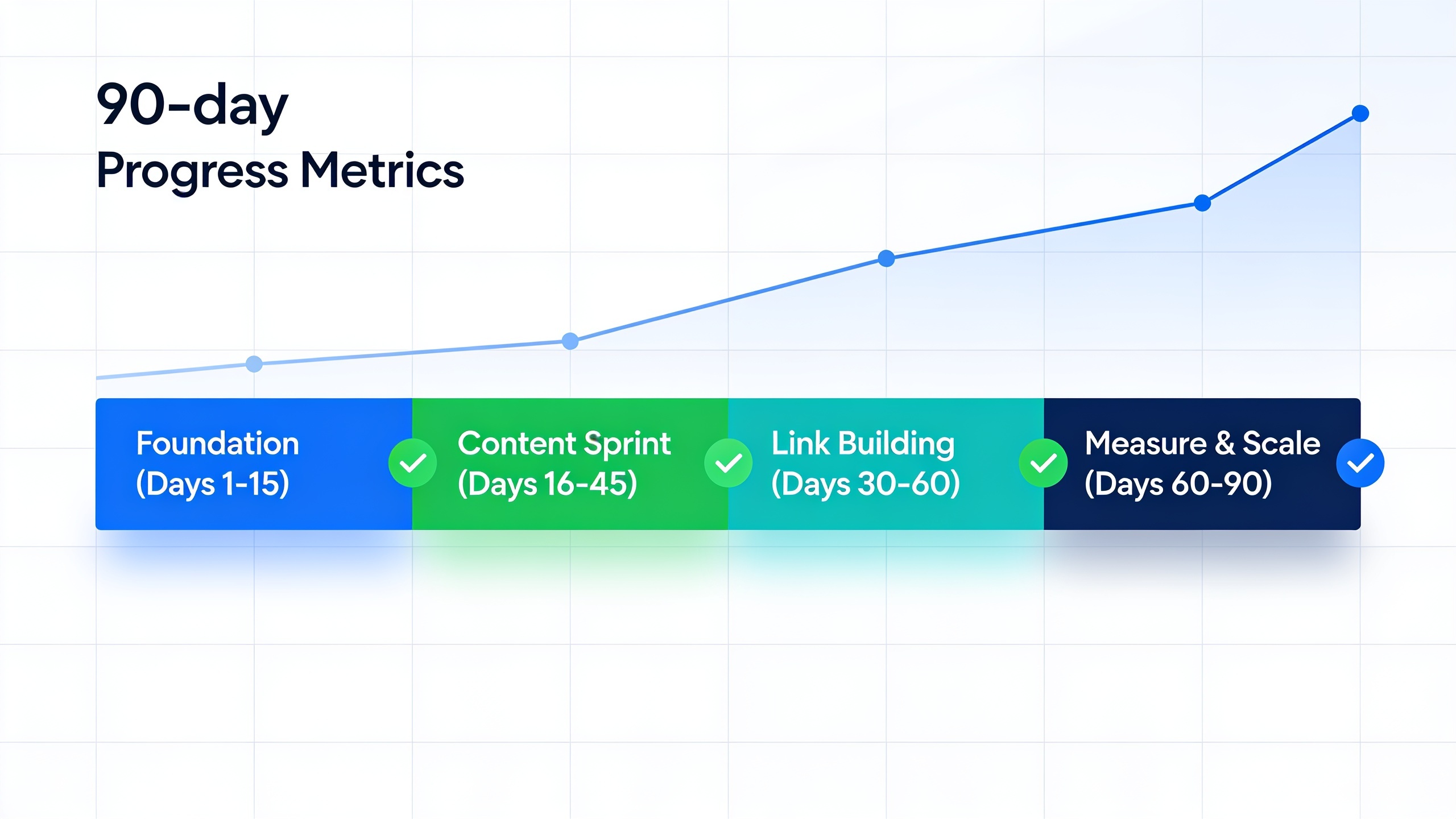
This whole plan assumes zero marketing hires at any point. Just you, a consistent weekly rhythm, and tools carrying the heavy production and link-matching load.
Frequently Asked Questions
Can a solo founder really rank on Google with no marketing hire at all?
Yes, but you're trading automation and consistency for headcount. Publish steadily, get the on-page basics right, build a modest number of relevant backlinks, and you can rank for competitive long-tail keywords without a team. It just takes longer than it would with a full crew, and you have to stay disciplined about that weekly review instead of tinkering daily.
How long before I see results if I've got no marketing background?
Organic results usually take months no matter how big your team is, because Google needs time to crawl, index, and weigh your content and links against everyone else. Expect early signs first (impressions, long-tail rankings) before any big keyword wins, and plan on a multi-month horizon, not a few weeks.
Is AI-generated content actually good enough to rank, or does it need heavy editing?
AI-drafted content can rank fine when it's genuinely useful, accurate, and reviewed by a human before it goes live. The risk was never that it's AI-written. The risk is publishing it without checking it for accuracy and voice. Treat AI output as a first draft, not a final one, and you're on safe ground even without an editorial team.
How many backlinks does a founder actually need to compete?
It swings a lot based on how competitive your niche is and how strong the pages already ranking are, which is why any blanket number is misleading. There's a proper way to think about it relative to your specific competition in How Many Backlinks to Rank on Page One? The Real Answer.
What's the single highest-leverage SEO task when you're short on time?
For most founders, consistent publishing plus a small number of relevant, verified backlinks beats any clever "hack." Pouring disproportionate time into perfecting one article or chasing one high-authority link tends to pay off less than steady, moderate effort spread across both content and links over several months.
---
Ranking on Google without a marketing team isn't about doing less SEO. It's about doing the same core work through a leaner system: automated drafting and publishing instead of a writing staff, exchange-based link building instead of cold outreach, and your judgment applied at review time instead of at every single step. The founders who get the furthest tend to do the same three things. They pick a narrow set of keywords, they stay consistent for months instead of weeks, and they let the tools carry the repetitive load so their own hours go toward the decisions only they can make.
Ready to stop writing content by hand? Start your free RobinRank trial and get a full month of SEO-optimized articles published on autopilot.