Turning Unlinked Brand Mentions Into High-Value Backlinks

Think about it. With normal link outreach, you're basically a stranger asking someone to write about you out of the goodness of their heart. Here it's completely different. Someone already decided you were worth mentioning. You're just asking them to finish the job.
This guide covers how to actually find these mentions, how to figure out which ones are worth your time (spoiler: not all of them), how to write outreach that doesn't get ignored, and what to do when a webmaster ghosts you anyway. I'll also get into the co-citation stuff, because understanding why this works makes you way better at doing it.
Table of Contents
- What Are Unlinked Brand Mentions?
- Why These Mentions Matter (and What Co-Citation Actually Is)
- How Do You Find Unlinked Brand Mentions Across the Web?
- How to Turn a Mention Into a Backlink
- When Outreach Goes Nowhere
- Measuring Whether Any of This Is Working
- The Mistakes That'll Waste Your Whole Afternoon
- FAQ
What Are Unlinked Brand Mentions?
An unlinked brand mention is any text on someone else's site that names your brand, product, domain, or a key person at your company without linking back to you. Simple as that. These show up on news sites, blogs, forums, review platforms, podcast show notes, competitor comparison pages, basically anywhere words live.
A few examples you'll run into constantly. A journalist quotes your CEO in some industry roundup, types out your company name, and never bothers to link it. A "best tools" listicle features your product, screenshot and all, with no link to your homepage. Someone on Reddit recommends your service by name in a thread. Or a guest post cites a stat from your original research and forgets the source URL entirely (this one drives me nuts, because they clearly did the work of finding you).
Here's why it matters. These mentions already carry some weight. Search engines can connect your brand name to the topic of the page even without a link. But you're missing out on the direct link equity, the referral traffic, and the crawl path that a real hyperlink gives you. Closing that gap is the whole point of this exercise.
Why These Mentions Matter (and What Co-Citation Actually Is)
Unlinked mentions matter because they're low-friction, high-intent opportunities. Someone already decided your brand was relevant enough to name, so you're not cold-pitching a stranger. You're just asking them to complete a citation they half-finished. That's a fundamentally easier conversation than "hey, please write about me."
Now for the theory nerds. There's a concept called co-citation SEO worth understanding. Co-citation is when two entities (brands, sites, people) get mentioned together on the same page or in the same context, with no hyperlink connecting them, and search engines use that pattern to infer a relationship. It's not the same as co-occurrence, which is just two terms happening to sit near each other in text. Google's own people, John Mueller among them, have said in Search Central hangouts that Google's systems can sometimes use unlinked mentions to understand entity relationships and reputation. An unlinked mention won't pass PageRank the way a link does, but it's not nothing either.
So what does this mean for you, practically? Three things.
First, unlinked mentions can build topical authority on their own. If ten publications name your brand in the context of "AI content marketing," that pattern reinforces the association whether or not any of them link to you. Second, they're a great signal that you're producing link-worthy stuff in the first place. A brand that gets mentioned a lot is clearly making content or products people find citation-worthy, which is exactly the raw material link building runs on. And third, most of the time the missing link is just an oversight. Writers forget. They reference a brand they heard about secondhand and never think to hyperlink it.
That last point is the real reason this tactic converts better than most guest post or resource page outreach. You're not begging for a favor. You're offering to help someone fix a small mistake.
How Do You Find Unlinked Brand Mentions Across the Web?
You find them by pairing manual search operators with brand monitoring tools that crawl the web and ping you whenever your name shows up somewhere new. The trick is doing this on a schedule, weekly or monthly, so it becomes an actual channel instead of a one-time cleanup you do once and forget about.
Start With Manual Searches (They're Free)
Before you pay for a single tool, run these in Google to see what's already out there:
- `"YourBrandName" -site:yourdomain.com` finds mentions everywhere except your own site.
- `"YourBrandName" -site:yourdomain.com -inurl:yourdomain.com` also filters out your subdomains and cached pages.
- `"YourBrandName" "review"` or `"YourBrandName" "alternative"` surfaces comparison and review content, which usually comes with strong buyer intent and solid link value.
- `intitle:"YourBrandName"` finds pages where you're prominent enough to make the title. Those are usually your best first targets.
This works fine. But it doesn't scale past a handful of searches, and it won't tell you when a fresh mention pops up next month. You'll forget to check. Everyone does.
Tools for the Ongoing Stuff
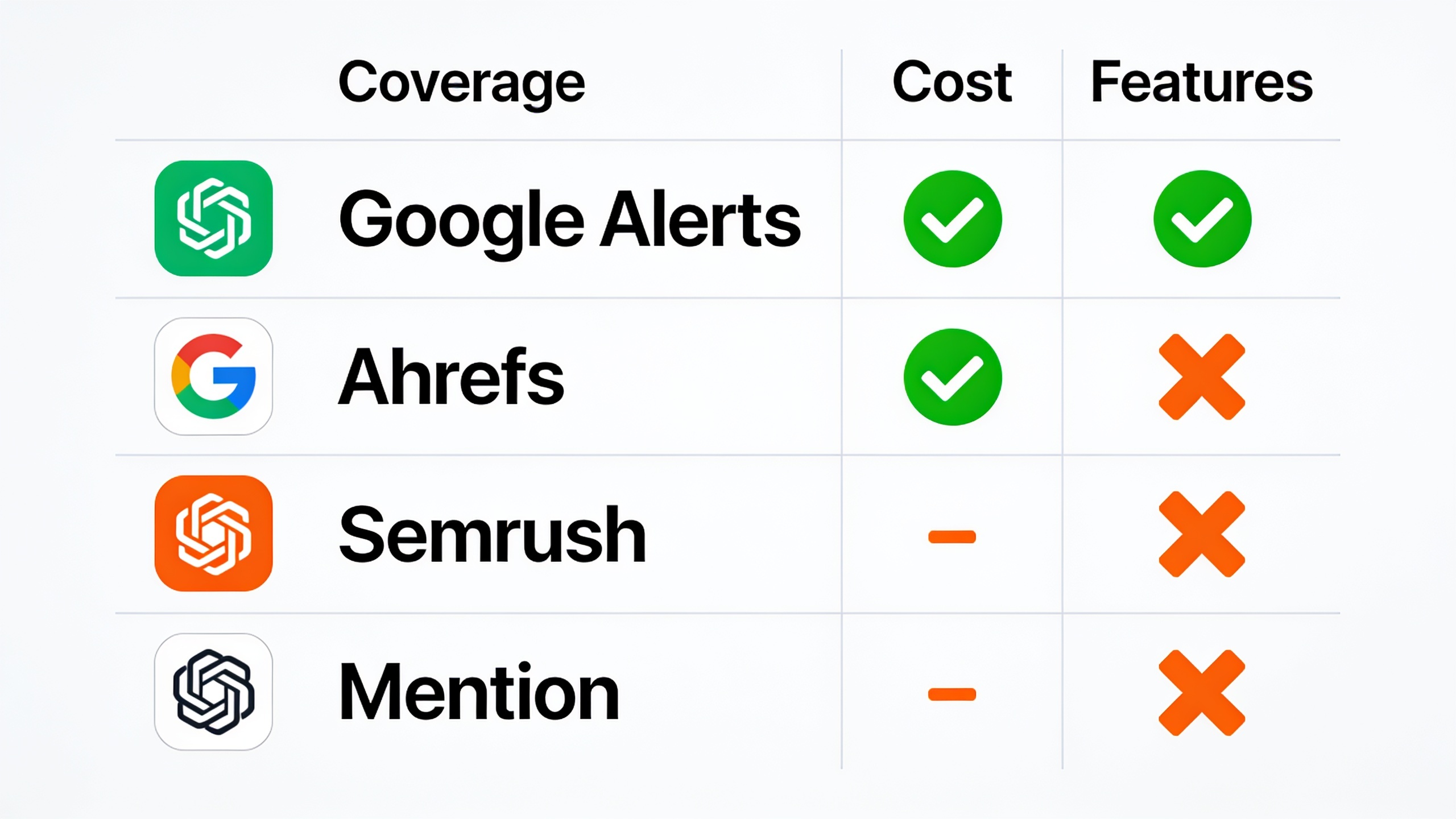
For continuous tracking, most SEO and PR teams lean on a mix of alerting tools and backlink platforms. Each one is good at a different thing, so plenty of teams run two side by side: one for wide web coverage, one for backlink context.
| Tool Type | Example Tools | Best For | Limitation |
|---|---|---|---|
| Free alert services | Google Alerts | Catching new mentions in news and blogs at no cost | Coverage is inconsistent and delayed; misses forums and social platforms |
| Social & web listening | Mention, Brand24, BrandMentions | Tracking mentions across social media, forums, and blogs in near real time | Typically a paid subscription; not focused specifically on link-building context |
| Backlink & mention databases | Ahrefs Alerts, Semrush Brand Monitoring | Surfacing mentions with domain authority data attached, so you can prioritize by site strength | Requires an existing subscription to the platform's broader SEO suite |
| Search Console + manual audits | Google Search Console, manual SERP checks | Free, but reactive rather than proactive | No dedicated "unlinked mention" feature; requires manual cross-referencing |
Whatever combo you land on, the workflow's the same. Capture the mention, note how strong and relevant the domain is, then sort out which ones actually deserve an email and which are too low-value to touch.
Deciding What's Worth Chasing
Not every mention deserves your time. Most don't, honestly. Here's how I'd triage:
Domain strength comes first. Go after sites with real authority in your niche. If you're not sure whether a domain's even worth the effort, it's worth reading up on Domain Authority vs Domain Rating: What Really Matters before you burn time chasing a placement that barely moves the needle.
Then relevance. A mention on a directly related industry blog beats a passing reference on some general-interest site every single time. After that, think about the page itself: a mention buried on page 40 of a dead forum thread is worth way less than one on a page that's actually ranking or getting shared around. And finally, context. Positive or neutral mentions are easy wins. A mention inside a scathing review? That's a completely different conversation, and sometimes not one you want to have through link outreach at all.
How to Turn a Mention Into a Backlink
You convert an unlinked mention by finding whoever runs the page, sending a short and specific request that points to the exact page and sentence where your brand shows up, and making it stupidly easy to say yes by handing them the anchor text and URL ready to paste. The whole thing should take them under 30 seconds to read and act on. If it takes longer, you've written too much.
Step 1: Find the Right Person
Check the author bio, the "Contact" or "About" page, or dig through WHOIS or LinkedIn to figure out who actually manages the content. For bigger publications, editors or content managers usually beat the original byline author, who's often long gone by the time you find the article.
Want content like this running on autopilot for your own site? Try RobinRank free — AI-written, SEO-optimized articles generated and published automatically, no credit card required.
Step 2: Write a Short, Specific Email
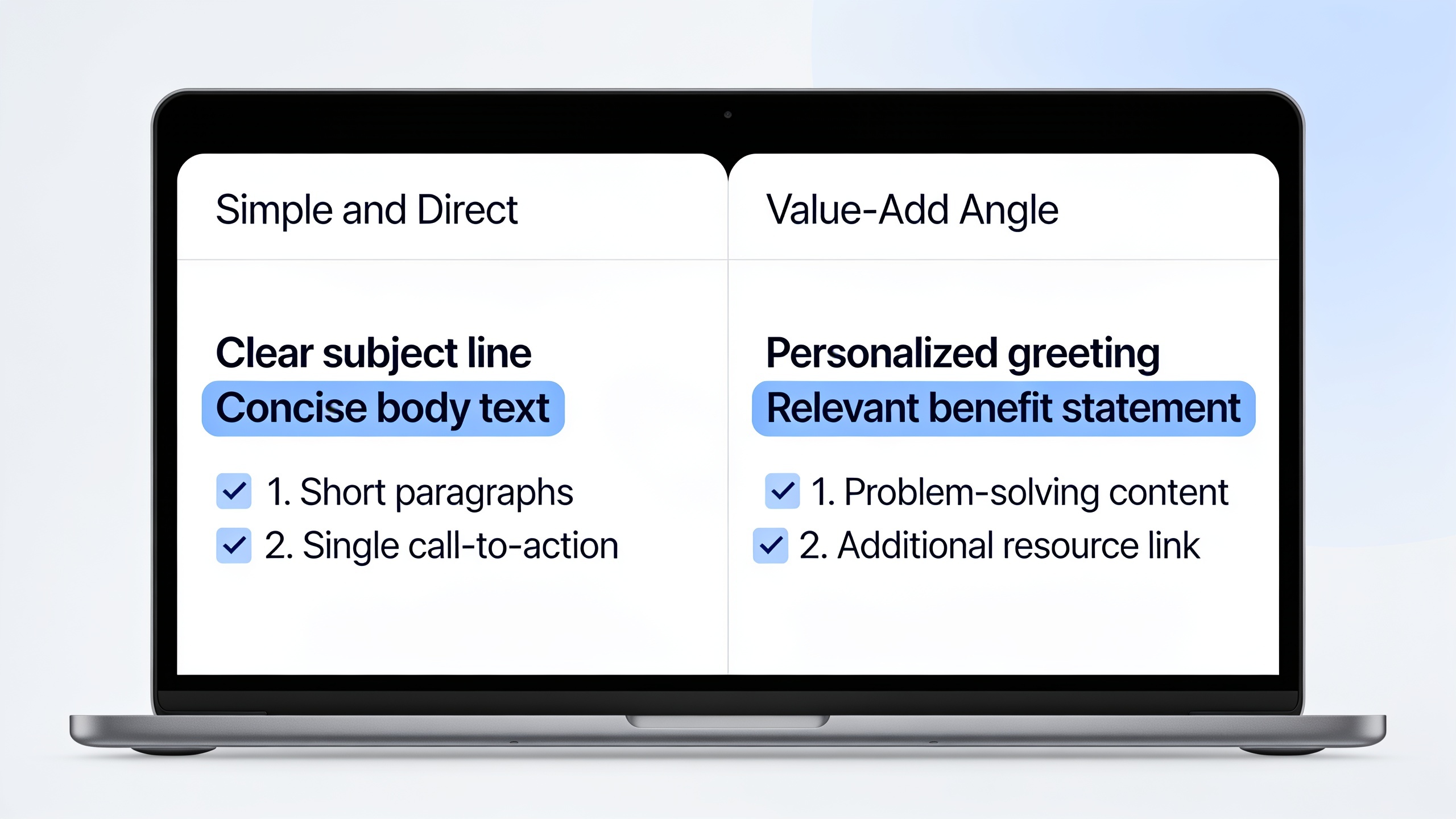
The email needs to name the exact page and sentence. Not "I noticed you mentioned us somewhere." Two scripts you can steal and tweak:
Script 1, simple and direct:
> Subject: Quick fix for your [Article Title] piece
>
> Hi [Name],
>
> I came across your article "[Article Title]" and noticed you mentioned [Brand Name] in the section about [topic]. Thanks for including us!
>
> Would you mind adding a link to [exact URL] so readers can find us directly? Happy to return the favor if you ever need a link from our resources.
>
> Thanks either way,
> [Your Name]
Script 2, the value-add angle (good when you've got a resource that backs up their point):
> Subject: Small addition for your piece on [topic]
>
> Hi [Name],
>
> Loved your recent piece on [topic] — the point about [specific detail] was well made. I noticed you referenced [Brand Name] but didn't link to us; would you mind adding [exact URL] so readers can dig into the source directly?
>
> Separately, we published a deep-dive on [related topic] that might be a useful addition to that section if it's relevant: [URL].
>
> Either way, thanks for the mention.
> [Your Name]
Keep it grateful, not demanding. You're asking for a favor, small as it is. And the numbers back up why the mention angle beats cold outreach: a widely cited BuzzStream and Fractl study on outreach found that average response rates for cold link-building emails sit in the single digits. Requests tied to an existing mention tend to do noticeably better, because there's already an implied relationship. They wrote about you. That changes the whole dynamic.
Step 3: Follow Up Once. Then Let It Go.
No reply within 7 to 10 business days? Send one polite follow-up. That's it. If they still go quiet, don't keep pestering the same person. Drop the mention onto a "revisit in 3 months" list and move on to the next one. Nobody's ever earned a link by being annoying.
When Outreach Goes Nowhere
When someone ignores you or flat-out declines, the smart move is to redirect that energy toward channels where the other party has already agreed to trade links, instead of chasing a cold contact who clearly isn't answering. Unlinked mention outreach has a real ceiling. Plenty of site owners just don't reply to unsolicited email, no matter how polite or specific you were.
This is where a structured link exchange network earns its keep. RobinRank, for one, is built around the opposite problem. Instead of firing off cold emails and praying, you browse a directory of manually reviewed site owners, filtered by niche and Domain Rating, who signed up specifically to trade placements. You request a spot on a particular page with the anchor text you want, offer a reciprocal link when it makes sense, and you're talking straight to the person who actually owns the site. Every site in RobinRank's Discover directory needs a minimum Domain Rating of 5 (per Ahrefs) and has to clear a manual review for quality and safety before it gets listed, which is meant to weed out PBNs, link farms, and thin doorway junk. Once a placement goes live, RobinRank crawls the page to confirm the href is really there, and on the Pro tier it keeps rechecking and pings you if the link ever vanishes. New sites get a 7-day free trial after approval, no card required, then it's $19/month and you can cancel whenever.
I want to be clear, though. The point isn't to give up on unlinked mention outreach. It's genuinely one of the higher-converting tactics out there precisely because the relationship already exists. But pairing it with a reciprocal exchange means you're not stuck depending on strangers hitting reply, which keeps the whole pipeline moving during those weeks when your mention outreach falls flat.
Measuring Whether Any of This Is Working
You measure a mention-to-link campaign by tracking three numbers over time: total mentions found per month, the percentage you converted into live links, and the change in referral traffic or rankings for the pages those links point to. The single biggest reason teams undervalue this whole tactic is that they treat it as a one-off cleanup instead of an ongoing program. Don't do that.
A basic tracking sheet should log the date you discovered the mention, the domain and specific URL, the domain authority or rating at the time, the outreach status (not contacted, emailed, follow-up sent, linked, declined), the date the link went live if it did, and the anchor text you used.
Review it monthly and patterns start jumping out. Certain publication types respond faster. Certain anchor text requests sail through approval more often. Certain niches are just friendlier to link requests than others. Give it a couple quarters and this data becomes genuinely useful, and not just for outreach. It feeds your broader internal linking strategy too, since a page that just earned fresh external links often deserves stronger internal links pointing at it from elsewhere on your own site.
The Mistakes That'll Waste Your Whole Afternoon
Most failed unlinked mention campaigns don't die from bad luck. They die from avoidable process mistakes. The usual suspects:
Treating every mention as equally valuable. Chasing a low-authority forum mention with the same effort you'd spend on a major publication is just throwing time away.
Sending generic, vague emails. If you don't name the exact page and sentence, you're getting ignored. Specific, easy-to-action requests win.
Never following up. Editors and bloggers miss emails constantly, they're drowning in inboxes. One polite follow-up can double your success rate, and yet most people quit after the first try.
Ignoring negative or neutral mentions completely. Sometimes those are your best PR signal even when they're not immediately link-worthy. They show you exactly where perception gaps are hiding.
And not tracking anything at all. Without a simple log, you literally cannot tell whether this channel works or just feels productive. Big difference.
FAQ
What's the actual difference between an unlinked mention and a backlink?
A backlink is a hyperlink from another site pointing to your domain, and it passes referral traffic plus link equity that search engines can crawl. An unlinked mention is just text naming your brand with no hyperlink. It might carry some semantic or reputational value through co-citation, but it doesn't give you the crawl path or the click-through that a real link does.
How fast can I actually turn a mention into a link?
No fixed timeline, but most successful conversions land within one to two weeks of a well-targeted, specific email. Sometimes faster if the person's responsive and the edit is quick for them. Mentions that stay silent even after a follow-up rarely convert unless you switch approaches, like leading with a value-add pitch or getting a warm intro.
Do unlinked mentions really help SEO if I never land the link?
They might. Based on public comments from Google reps like John Mueller, they may feed into how search engines understand your brand's association with a topic through co-citation and entity recognition. But an unlinked mention doesn't pass the direct ranking signal or referral traffic a real link gives you, so treat it as a supplement, not a substitute for actual backlinks.
What tools work best for finding these mentions?
A practical setup mixes a free alerting tool like Google Alerts for baseline coverage, a web/social listening tool such as Mention or Brand24 for broader real-time tracking, and a backlink-focused platform like Ahrefs or Semrush so you can prioritize by domain authority. And keep running those manual Google searches with the `-site:yourdomain.com` operator between monitoring cycles. Free and surprisingly effective.
Should I chase every single mention I find?
Nope. Prioritize by the strength and relevance of the domain, the traffic potential of the specific page, and the context of the mention. A relevant mention on an authoritative, actively-trafficked industry page deserves real effort. A stale forum post about something unrelated usually doesn't.
Look, turning unlinked mentions into backlinks won't replace your whole link-building program. But it's one of the very few tactics where the hardest part, getting someone to talk about you in the first place, is already done. Set up a simple monitoring habit, prioritize ruthlessly, keep your emails short and specific, and pair it with a reliable exchange channel for the ones who never write back. Do that steadily for a quarter and you'll have a quiet, low-cost stream of links that most of your competitors are still leaving on the table.
Ready to stop writing content by hand? Start your free RobinRank trial and get a full month of SEO-optimized articles published on autopilot.