White-Label Content Production: A Playbook for Agencies

If you're not familiar, white-label content production just means you outsource the writing (and often the editing and publishing too) to some third party, then hand the finished work to clients wearing your own agency's badge. The client never knows there's a factory floor behind the curtain. Done right, it lets a scrappy five-person shop keep twenty clients' content calendars humming. Done badly? You end up shipping generic mush that all sounds the same, and clients start to notice. That's a slow-motion reputation problem.
So this is a playbook for doing it right. What white-label production actually involves, how to build a pipeline that won't collapse under its own weight, what it costs to run, and the specific ways agencies faceplant. Whether you're adding content as a shiny new line item or trying to duct-tape a process that's already groaning, the goal's the same: consistent quality at a volume your current team simply can't hit on its own.
Table of Contents
- What Is White-Label Content Production?
- Why Agencies Are Turning to White-Label Content for Agency Content Scaling
- How Do You Build a White-Label Content Pipeline?
- In-House vs. Freelance vs. AI-Assisted Production: Choosing a Model
- How Much Should You Charge for White-Label Content Production?
- Quality Control and Brand Voice at Scale
- Link Building and Distribution: Completing the Package
- Common Mistakes Agencies Make When Scaling Content
- Frequently Asked Questions
What Is White-Label Content Production?
White-label content production is when you have someone else write, edit, and format your content (blog posts, landing pages, case studies, email sequences, whatever) and then you rebrand it and deliver it to clients as if it came straight out of your own office. The client only ever talks to you. You're the face, the account manager, the quality gatekeeper. The writer might be a freelancer in another time zone or a piece of software, and the client is none the wiser.
The name comes from manufacturing, by the way. A factory cranks out a generic product, and retailers slap their own label on it and sell it as theirs. Same idea here. Except your "factory" might be a freelance writer network, a specialized content shop, or increasingly some AI-assisted platform that drafts and optimizes articles for a human editor to clean up before it goes out. And that's the whole trick, really. It doesn't matter who writes the thing. What matters is the client only sees your brand, your tone, your account management. Never the machinery underneath.
Why does any of this matter to an agency? Because content is basically table stakes now. Clients expect blog posts and SEO pages and social copy bundled in with the strategy and the media buying, and they expect it constantly. But hiring a full-time writer for every niche and skill your client roster demands? That math almost never works out. White-label production is how you close that gap.
Why Agencies Are Turning to White-Label Content for Agency Content Scaling
The whole point of agency content scaling is cranking out more content for more clients without your payroll ballooning to match. That's the number one reason agencies go white-label. Try to scale by hiring full-time writers and you hit a wall fast, because recruiting and training and managing people takes months, and client demand almost never shows up in a nice tidy predictable curve. It comes in lumps.
White-label production snaps the connection between headcount and output. You're not hiring a new writer every time a client wanders into a new niche. SaaS this month, home services next month, healthcare after that. Instead you tap a bigger pool of specialists or a platform that can juggle multiple verticals at once. Honestly, this is also why a lot of agencies decide to make content a real, distinct offering instead of some vague bolt-on. If you're still figuring out how to package the thing, the piece on how agencies can add a content marketing service offering covers the positioning decisions that usually come before you even worry about production.
And then there's margin, which nobody likes to say out loud but everybody's thinking about. When you pay a vendor or a platform a base rate and charge the client a retainer that folds in strategy, editing, and account management, you can often make healthier money on content than you would running an in-house team that sits idle between projects. The catch? That margin lives or dies on how tightly you control quality and turnaround. Which is exactly what the rest of this playbook is about.
How Do You Build a White-Label Content Pipeline?
A white-label content pipeline is just the repeatable, documented workflow that carries a piece of content from "client brief" to "polished, client-ready asset" without your senior people having to babysit every single step. Get it right and it runs mostly without you. There are four pieces to it: a way to source writers or tools, standardized briefs, an editorial review layer, and a delivery system so seamless the client never spots the joins.
Sourcing Writers or Production Partners
Most agencies pick from three sourcing routes: a vetted freelance bench, a dedicated content agency partner, or a software platform that automates the drafting. What's right for you mostly comes down to your client mix. A roster stuffed with niche B2B accounts might genuinely need subject-matter experts who know the space. A roster of local service businesses? A more templated, software-driven approach will probably do just fine. Plenty of agencies run a hybrid, and honestly that's usually the smart move: freelancers for the flagship thought-leadership stuff, a faster automated process for the high-volume SEO posts and location pages nobody's going to win awards for.
Standardizing the Brief
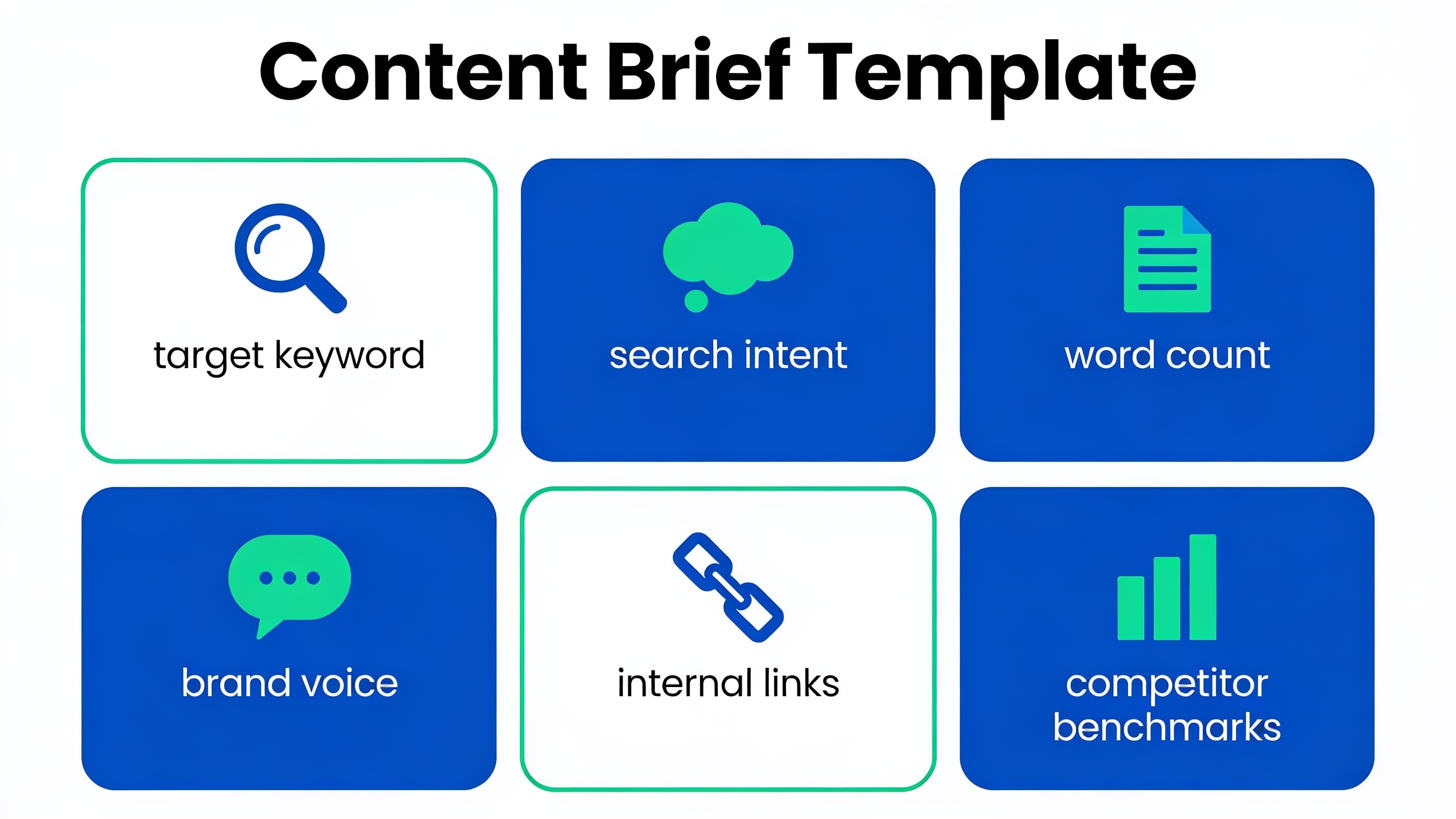
Every single piece should kick off from a brief. Target keyword, search intent, word count, brand voice notes, internal linking requirements, a competitor or two to benchmark against. Skip this and you'll spend your "saved" time doing rewrites, which defeats the entire purpose of outsourcing in the first place. Build one reusable brief template, adapt it per client, and you've got maybe the single highest-leverage document in your whole operation. I'm not exaggerating.
Building the Editorial Layer
This is the step that decides whether white-label production protects your reputation or slowly torches it. You need one editor, even a part-timer, to read every piece against the brief, check the facts and claims, and confirm the thing actually sounds like the client instead of some generic vendor. This is also where the SEO bits get locked down: title tags, meta descriptions, header structure, internal links. All finalized here, before anything reaches the client or goes live.
Delivery and Reporting
The client gets a clean, on-brand deliverable, usually a formatted doc or a straight CMS upload, plus whatever reporting the retainer promised (traffic, rankings, leads, take your pick). If you also own distribution, this is where content plugs into the lead-gen machinery. The guide on turning blog traffic into leads is a genuinely useful companion here, especially if your retainers promise conversions and not just a pile of published word counts.
In-House vs. Freelance vs. AI-Assisted Production: Choosing a Model
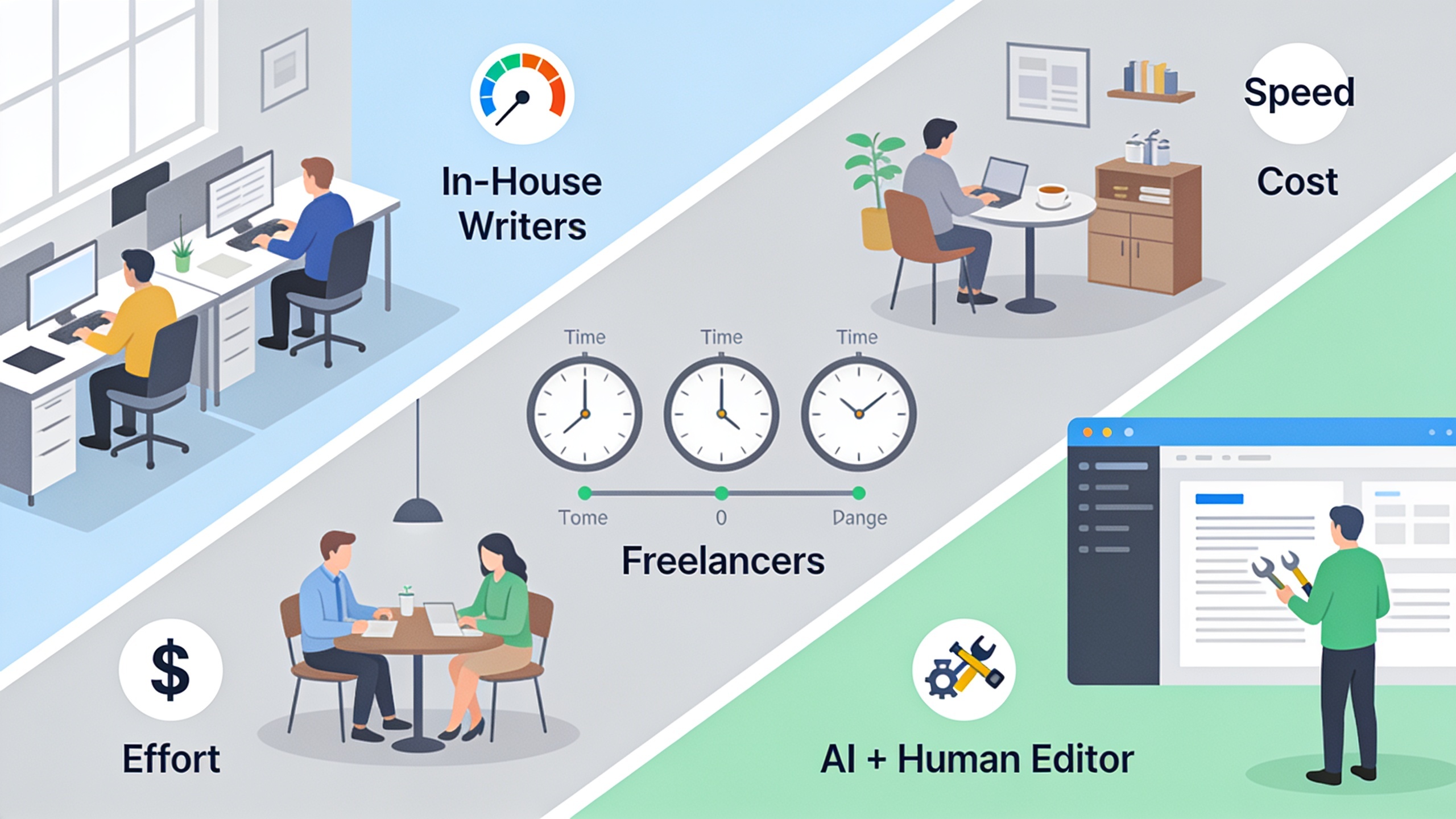
There's no universally correct model. The right one depends on your client volume, your budget, and how much editorial oversight you can actually afford to staff. Here's how the three most common approaches stack up.
| Model | Speed to Scale | Cost Structure | Editorial Burden on Agency | Best Fit |
|---|---|---|---|---|
| In-house writing team | Slow — bound by hiring and onboarding time | Fixed salary cost regardless of volume | Lower per-piece (writers already know brand voice) | Agencies with a stable, high-volume client base in a narrow niche |
| Freelance/vendor network | Moderate — bound by vendor availability and vetting | Variable, per-word or per-piece | Higher — every new freelancer needs brief training and QA | Agencies with varied client niches and unpredictable volume |
| AI-assisted / software-augmented production | Fast — output isn't bound by hiring at all | Typically subscription or per-article software cost plus editor time | Moderate — human review still required before client delivery | Agencies scaling volume quickly across many clients at once |
Nearly every agency that scales past a handful of content clients lands on a blended model in the end. A small in-house or trusted freelance core handles the flagship and highly technical pieces, and a faster, more automated process takes care of the standard SEO stuff. This is roughly where a platform like RobinRank slots in. It's built to automatically write, optimize, and publish articles, which lets you compress the drafting and on-page optimization stages I described above, so your editors can spend their brainpower on brand-voice review and strategy instead of grinding out first drafts.
Want content like this running on autopilot for your own site? Try RobinRank free — AI-written, SEO-optimized articles generated and published automatically, no credit card required.
How Much Should You Charge for White-Label Content Production?
Agencies usually price white-label content one of three ways: per article, as a monthly retainer, or baked into a bigger SEO or marketing package. Which one fits depends mostly on how predictable the client's needs are. Per-article pricing is great for clients with lumpy, irregular demand. Retainers work better when you want steady monthly revenue and can commit to a fixed cadence, say four to eight articles a month.
Whatever you land on, the price has to cover way more than the writer's fee or the software subscription. It has to swallow the editorial review, project management, revisions, and any SEO or distribution work you've bundled in. Agencies that just take the vendor cost and slap a thin markup on top? They watch their margin evaporate the second a client asks for a chunky revision round. Build a little buffer into your pricing for revisions and QA time. It's one of the most consistently forgotten line items in the whole game, and it'll save you.
Oh, and decide upfront whether link building and distribution live inside the content package or get sold separately, because that choice changes both your cost basis and what you can promise the client. More on that in the next section.
Quality Control and Brand Voice at Scale
Quality control is the set of checks (factual, structural, stylistic) that confirms a piece actually sounds like the client's brand and won't fall apart under scrutiny before it ships. Skip the QC step and "white-label" quietly turns into "unlabeled," and pretty soon clients start noticing that everything across every account reads like it came off the same conveyor belt. Which, well, it did.
A workable QC checklist for an agency scaling content usually covers a few things:
- A brand voice guide per client, spelling out tone, banned phrases, formatting quirks, and point of view (first person, third person, that kind of thing)
- A fact-check pass on every statistic, claim, or named example before it goes out
- An SEO pass confirming keyword placement, header hierarchy, and internal links are all where they should be
- A final read-aloud, plus a plagiarism or AI-detection check if the client's touchy about how the content was made
That brand voice guide is worth building even for a single client. It becomes the reference doc every new writer, editor, and software workflow gets pointed at, and it's the one artifact keeping your output consistent as you pile on more accounts. Agencies that skip it tend to find out the hard way, usually when a client emails to say "this doesn't sound like us." And fixing that after publication is a far more expensive headache than catching it before.
Link Building and Distribution: Completing the Package
Content on its own rarely satisfies an SEO-focused retainer. Clients increasingly expect you to handle the promotion and the link acquisition too, because a published article with no external signals just sits there and ranks slower than one propped up by relevant backlinks. Link building, if you need the definition, means getting hyperlinks from other sites pointing back to your client's content, which search engines treat as a signal of a page's relevance and authority.
The trouble is that traditional link building via cold outreach is slow, grindy, labor-intensive work. Which is exactly why a lot of agencies bundling white-label content go hunting for a more direct route to placements. RobinRank's exchange network takes a different angle: site owners browse listings by niche and Domain Rating (measured via Ahrefs), request a placement directly, and offer a reciprocal link back. So instead of firing cold emails into the void, you're having actual conversations with real site owners. Every site gets manually reviewed before it's listed, and RobinRank crawls and re-checks placements weekly to make sure the link is still live, which means you can show clients verified proof a placement exists instead of just taking a vendor's word for it. The Pro plan comes with a 14-day free trial, no credit card needed, and after that it's $19 a month for unlimited site listings, link requests, Discover filtering by niche or Domain Rating, and the automatic placement verification.
Pairing verified link exchanges with your white-label written content lets you offer a fuller SEO package without standing up a whole separate outreach team, which loops right back to the theme running through all of this: doing more for clients without your internal headcount climbing to match.
Common Mistakes Agencies Make When Scaling Content
Most white-label programs don't fail because the writing was bad on day one. They fail because the process that was supposed to guard quality slowly rots as volume climbs. A handful of patterns show up over and over.
Treating the brief as optional. Under deadline pressure, agencies sometimes skip the detailed brief to "save time." It backfires almost every single time. Vague briefs beget generic drafts, generic drafts need heavy editing, and there goes the time you thought you saved.
Letting one person be the entire QC layer. When a lone editor becomes the chokepoint for every client's content, your scaling grinds to a halt the moment they take a vacation or get sick. Document the brand voice guides and the QC checklists so the review step doesn't depend on one irreplaceable human.
Underpricing revisions. Flat per-article pricing that ignores revision rounds bleeds margin fast, especially with new clients who haven't calibrated their expectations with you yet.
Ignoring distribution. Publish content with zero link-building or promotion behind it and clients start wondering why traffic isn't moving, even when the writing's genuinely good. That's why pairing production with a distribution or link-building layer, and with lead-conversion tactics like the ones in the content lead generation playbook, tends to keep clients around longer than content alone ever will.
Locking into one production model too early. Going all-in on an in-house team, or all-in on freelancers, before you understand your client volume patterns can trap you in a cost structure that doesn't match real demand for months. Give yourself room to figure it out.
Frequently Asked Questions
Is white-label content production just ghostwriting with extra steps?
They overlap, but no, not quite the same thing. Ghostwriting usually means one writer producing content under someone else's name, often for thought leadership or executive bylines. White-label content production is broader. It's an agency-level system: sourcing, briefing, editing, delivery. That system might spit out ghostwritten executive content as one of its outputs, but it's a lot bigger than ghostwriting alone.
How many clients can a small agency actually handle with a white-label pipeline?
There's no magic number, sorry. It comes down to your production model and how much editorial oversight each piece demands. A pipeline with solid brief templates, a defined QC checklist, and a mix of vetted freelancers or software-assisted drafting can usually support more concurrent clients than a purely in-house setup, simply because output isn't handcuffed to how many full-time writers you managed to hire.
Do we have to tell clients the content comes from a third party or an AI tool?
This is a business and contractual call each agency should make out loud and on purpose, not leave floating in the fog, because expectations swing wildly by client and industry. What matters most day to day is that whatever you deliver clears your own quality bar and brand-voice standards, no matter how it was produced.
Can AI-assisted production just replace human editors entirely?
Based on how agencies actually operate right now, no. Even the fast, software-augmented drafting workflows still benefit from a human passing over the thing to check facts, tone, and brand fit before it reaches the client. Think of AI tools as compressing the drafting and optimization stages, not deleting editorial oversight from the equation.
Does white-label content production include link building?
Not automatically. Link building usually gets sold as a separate service or an add-on, though plenty of agencies bundle the two because clients increasingly want content and promotion handled together. Whether you bundle comes down to your capacity and whether you've got a reliable way, like a verified link exchange network, to land placements without running a full outreach operation.
Building a white-label content pipeline isn't really about hunting down the perfect vendor. It's about designing a process (briefs, editorial checkpoints, pricing, distribution) that holds together as your client volume grows. The agencies that treat each of those pieces as a documented system, instead of something living precariously in one person's head, are the ones that scale content revenue without scaling their stress right along with it.
Ready to stop writing content by hand? Start your free RobinRank trial and get a full month of SEO-optimized articles published on autopilot.