Why Editorial Automation Is the Future of Content Teams

And that matters more than it used to. The old content team setup, where a writer, an editor, an SEO person, and a publisher all put their hands on every single piece, was designed for a slower world. Publishing volume was low, search wasn't a bloodbath, and you could afford to move deliberately. That world is gone. Companies now need steady output across blogs, landing pages, and (this is the newer wrinkle) AI answer engines, usually with the same headcount they had two years ago or fewer. Editorial automation is the thing making that math work, and it's genuinely changing what a content team even looks like.
Table of Contents
- What Is Editorial Automation, Exactly?
- Why Traditional Content Team Structures Are Breaking Down
- How Editorial Automation Actually Works
- What Changes for Human Roles on the Team
- Manual Workflows vs. Editorial Automation: A Side-by-Side Look
- Is Editorial Automation Right for Every Content Team?
- How to Start Adopting Editorial Automation Without Disrupting Your Team
- Frequently Asked Questions
What Is Editorial Automation, Exactly?
Editorial automation means software-driven systems that plan, produce, optimize, and publish content with barely any manual work at each step. Instead of a person researching a topic, banging out a draft, hand-formatting it for SEO, and then uploading it to a CMS, an automated system takes over some or all of that chain. It runs on rules, templates, and increasingly on AI models trained to write in a specific voice and structure.
One thing worth getting straight: editorial automation is not the same as a grammar checker or a scheduling calendar. Those are little one-trick tools that help with a single step. Editorial automation stitches multiple stages together into one flow. Topic and competitor analysis, draft generation, all the on-page SEO stuff (titles, meta descriptions, headings, internal links, schema markup), and then publishing straight into something like WordPress or Ghost. The point isn't to fire your editorial brain entirely. It's to get rid of the mechanical, repeatable stuff that doesn't need a human weighing in every single time.
If you want to see how this plays out from start to finish, How to Automate Your Content Pipeline From Idea to Publish walks through each stage in a lot more detail.
Why Traditional Content Team Structures Are Breaking Down
The old team structures are cracking because the ratio of "how much we need to publish" to "how many human hours we actually have" has gone completely sideways, and manual workflows just don't scale with that. A calendar that used to mean two articles a week now often means daily output across a bunch of formats and channels, just to stay in the game in organic search and, more and more, in AI-generated answers.
A few things are pushing this.
First, search and AI discovery blew up the surface area content has to cover. Ranking on Google isn't the finish line anymore. Your content also has to be structured so AI assistants like ChatGPT, Claude, Perplexity, and Gemini can find it, parse it, and cite it. That means more attention on entity clarity, source citations, structured data, all of which piles extra steps onto a process that was already stretched thin.
Second, hiring hasn't kept up. Most startups, agencies, and small businesses flat-out don't have the budget to staff a full content team of writers, editors, and SEO specialists. They need the output that used to take four or five people, and they need it from one or two.
And then there's the SEO grind itself. Writing a compliant SEO title, a meta description, an internal linking structure, and schema markup for every article is necessary work, sure, but it's also the kind of thing that doesn't need a fresh creative decision each time. It needs consistency. Which, funny enough, is exactly what machines are great at and humans are terrible at.
So that's the backdrop for how content teams are getting redefined. Not fewer people doing content. The same people doing better content, while systems quietly eat the repetitive layers underneath.
How Editorial Automation Actually Works
Editorial automation works by chaining together the stages of content production (research, drafting, optimization, publishing) into one automated or semi-automated pipeline, instead of treating each stage as a separate manual chore handed off to a different person. The exact mechanics change from platform to platform, but the shape of it is usually pretty consistent.
Stage 1: Analysis and Planning
Before a single word gets written, the system usually digs into the niche, competitor content, and target metrics like Domain Rating to figure out which topics are even worth writing. This is the part that replaces a strategist manually clicking through competitor blogs and keyword tools one tab at a time.
Stage 2: Drafting and On-Page Optimization
Once a topic's picked, the system spits out a draft that already has the SEO fundamentals built in. Headings, meta descriptions, internal links, schema, all of it, rather than needing a separate SEO pass after the writing's done. RobinRank, for one, generates SEO-optimized titles, meta descriptions, and headings automatically, drops in real citations and internal/external links, and produces JSON-LD schema markup as part of the draft. And it's all still fully editable before anything goes live, which matters more than people expect.
Stage 3: Publishing
Instead of a person copy-pasting a finished draft into a CMS, automated systems plug straight into WordPress or Ghost (or push through a webhook or custom API) and publish on a set schedule. Honestly, this is the step that changes team life the most, because it kills the "somebody has to log in and hit publish" bottleneck that's responsible for half the content calendars that quietly slip a week behind.
Stage 4: Verification and Distribution Signals
In the more advanced setups, publishing isn't actually the last step. There's a layer that keeps tabs on whether the links and mentions tied to your content stay live and verified over time. Because a link that got removed or a page that got unpublished doesn't do anything for your authority anymore, and you'd rather know.
What Changes for Human Roles on the Team
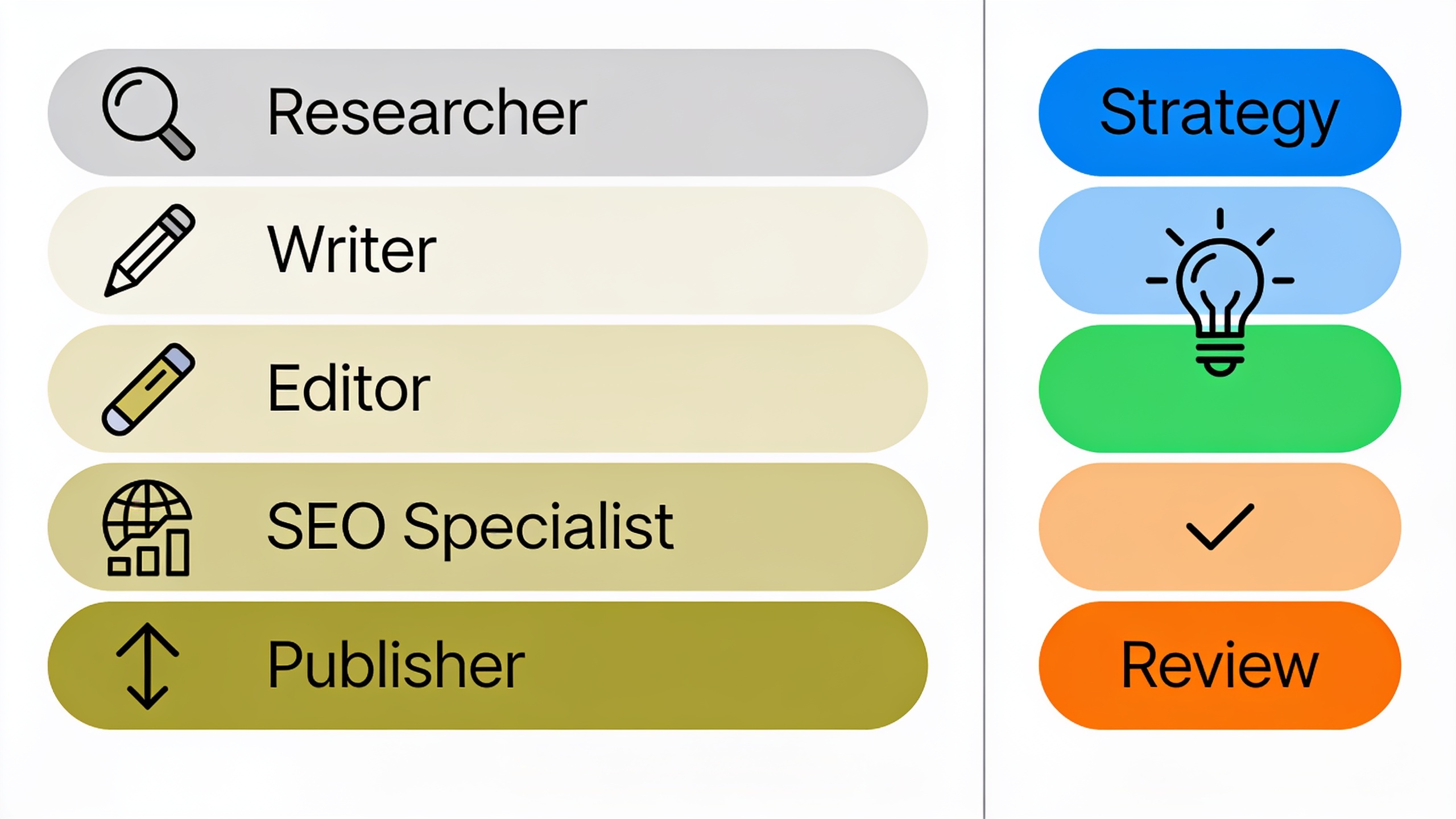
The biggest change here isn't fewer jobs. It's a shift in what the jobs are for. When drafting, formatting, and publishing get automated, the human work moves upstream toward the decisions a system genuinely can't make well on its own: strategic direction, brand voice, and quality judgment.
This is worth sitting with for a second, because it's the whole argument the industry keeps having. The Rise of AI Writers: Are Human Content Teams Obsolete? gets into this tension head-on, whether AI writing tools are actually replacing human teams or just changing what those teams spend their hours doing.
In practice, automation tends to redistribute human attention across three areas. There's strategic prioritization, where somebody still has to decide which markets, products, or customer questions matter most this quarter. Automation can surface topic opportunities from competitor and keyword data all day long, but deciding which of those opportunities actually line up with the business is a human call, full stop. There's editorial review and brand fit, because even a perfectly editable auto-generated draft needs a human deciding whether the tone, positioning, and claims sound like the brand and are, you know, true. And there's distribution and relationship strategy, where the where-and-how of amplifying content (backlink relationships, partnerships, community placements) still leans on actual human relationship management, even when the mechanics of matching and verifying links are automated.
Want content like this running on autopilot for your own site? Try RobinRank free — AI-written, SEO-optimized articles generated and published automatically, no credit card required.
Manual Workflows vs. Editorial Automation: A Side-by-Side Look
The gap between a fully manual workflow and an automated one gets a lot clearer when you put every stage next to each other.
| Workflow Stage | Manual Process | Editorial Automation |
|---|---|---|
| Topic research | Individual researches competitors and keywords manually | System analyzes niche, competitors, and Domain Rating to surface topics |
| Drafting | Writer produces draft from scratch | AI generates a structured draft with headings and citations |
| SEO optimization | Separate SEO pass after writing (titles, meta, schema) | Built into the draft generation step automatically |
| Internal/external linking | Manually researched and inserted | Natural links, including community backlink opportunities, added during drafting |
| Publishing | Manual copy-paste into CMS | Direct publishing to WordPress, Ghost, or via webhook/API on a set schedule |
| Link/authority tracking | Rarely tracked systematically | Verified, DR-weighted tracking of live outbound and inbound links |
| Human time required per article | High — touches every stage | Lower — concentrated on review and strategy |
The core takeaway from all that: automation doesn't delete the stages of editorial work. It compresses the ones that don't need a fresh human decision each time, and leaves review and strategy where they belong, with people.
Is Editorial Automation Right for Every Content Team?
Editorial automation fits best on teams that need steady publishing volume without a matching bump in headcount. But it's not a universal fit, and I'd be lying if I said otherwise. Teams doing highly technical, deeply reported, or investigative work, where original interviews, proprietary data, or specialized expertise is the whole point, are still going to need heavy human involvement at the drafting stage. Automation can handle the SEO and publishing scaffolding around it, but the actual reporting? That's you.
Where it does shine is anywhere the volume pressure is real and the bandwidth isn't. That's:
- Startup founders and small business owners who need a consistent content presence but can't justify a whole content department.
- Marketing agencies juggling content across a pile of client accounts, where consistency and speed matter at least as much as going deep on any one article.
- SEO professionals trying to scale output to match all the keyword and topic openings their competitive analysis keeps turning up.
- In-house content marketers at growing companies who keep getting told to "do more with the same team."
The thread running through all of them is the same: volume pressure plus limited human bandwidth. Which is exactly the itch editorial automation was built to scratch.
How to Start Adopting Editorial Automation Without Disrupting Your Team
The safest way in is to automate the most repetitive, least-judgment-dependent parts of your workflow first, rather than trying to flip a switch on the whole thing overnight. Publishing schedules, on-page SEO formatting, and basic topic research are usually the easiest places to start because they follow predictable rules. Drafting can come later, once you actually trust the output and have a real review process in place.
A rollout that tends to go smoothly looks something like this:
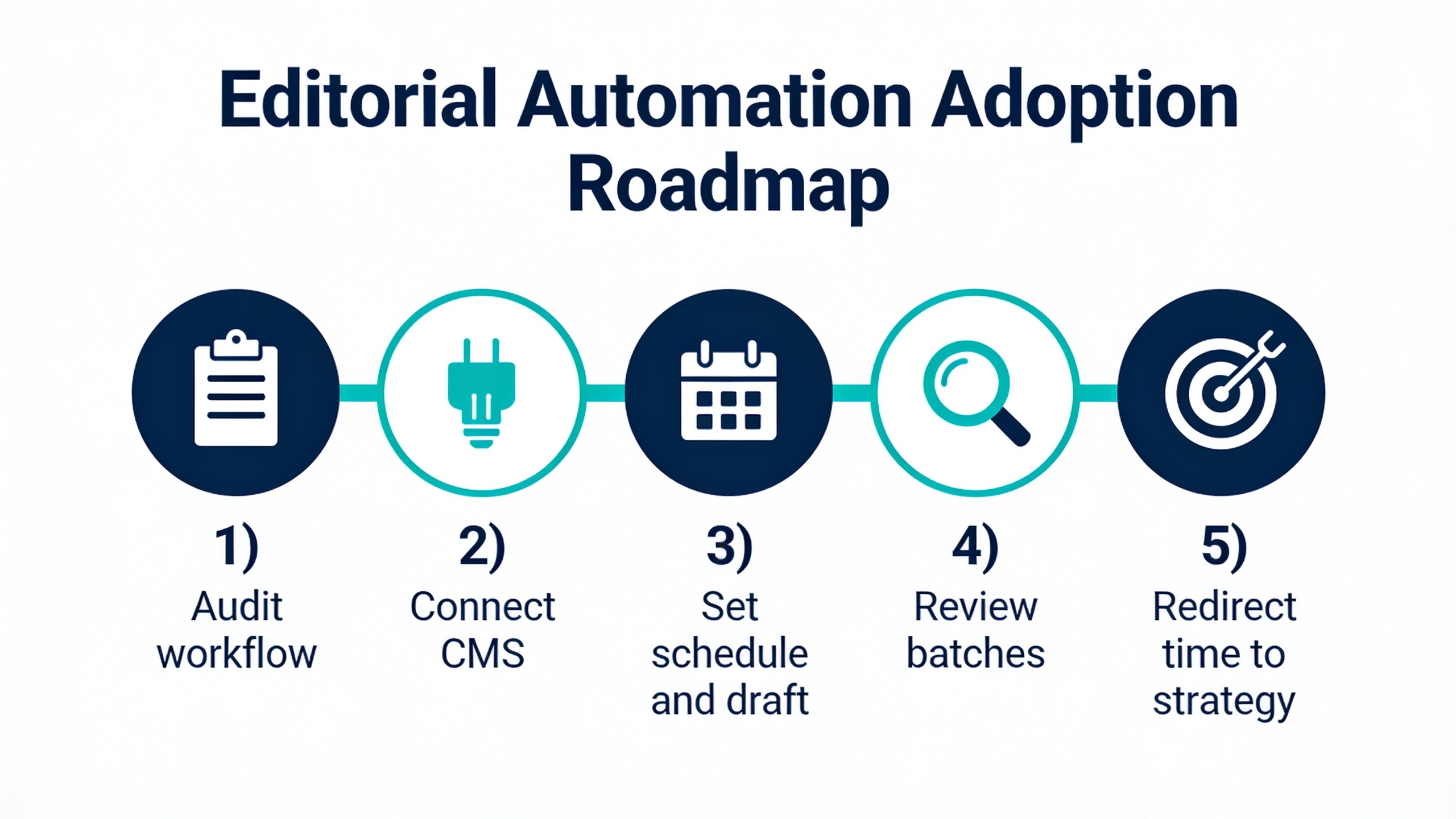
- Audit your current workflow and split every step into "purely mechanical" (formatting, scheduling, uploading) versus "needs judgment" (tone, accuracy, strategy). This alone is clarifying.
- Connect your CMS to whatever platform you pick, so publishing stops depending on someone remembering to log in.
- Set a schedule and let the system draft on a recurring basis, but keep every draft editable before it goes live. Do not jump to fully unattended publishing on day one. Please.
- Read the first few batches closely to calibrate tone, factual accuracy, and SEO quality before you crank up the volume.
- Actually redirect the freed-up time toward strategy and review, instead of letting it silently evaporate into whatever other fires are burning.
This staged thing protects your quality while still getting you the real payoff: more consistent output without hiring three more people to get there.
Frequently Asked Questions
So is AI just writing everything now with zero human involved?
Not really, no. Most editorial automation platforms, RobinRank included, generate fully editable drafts that a human can review, tweak, and approve before publishing, rather than shoving content live untouched. How much review actually happens is a call each team makes. It's not baked into automation itself.
Is this going to replace content writers and editors?
It changes what those roles focus on more than it wipes them out. The repetitive stuff (formatting, basic SEO tagging, manual publishing) gets absorbed, and the roles drift toward strategy, quality review, and brand judgment. There's a fuller take on this in The Rise of AI Writers: Are Human Content Teams Obsolete?.
What's the actual difference between editorial automation and just using an AI writing tool?
An AI writing tool usually does one thing: generate text. Editorial automation connects a bunch of stages together (topic research, SEO optimization, direct publishing to a CMS on a schedule) so the whole thing runs as a pipeline instead of a series of disconnected manual handoffs.
Can a solo founder without any SEO background realistically pull this off?
Yeah, that's honestly one of the main reasons these tools exist. The platforms built for it handle niche and competitor analysis, on-page SEO, and CMS publishing automatically, which drops the technical barrier way down for people who don't have SEO chops in-house.
How does this affect backlinks and off-page SEO?
Some platforms push past on-page content into link building too. RobinRank, for example, matches published articles with contextual backlink opportunities inside a community network, tracks whether those links stay live, and issues Domain Rating-weighted credits once outbound links are verified. Basically it folds content production and backlink work into one workflow instead of two separate slogs.
---
Editorial automation was never really about pulling people out of the content process. It's about pulling out the parts that never needed a person's full attention to begin with. And as search and AI discovery keep raising the bar on how much solid, well-structured content a brand has to ship, the teams that come out ahead are going to be the ones that let systems own the repeatable mechanics of research, optimization, and publishing, while keeping human judgment pointed at strategy, voice, and quality. That reshuffling of effort, not some headcount bloodbath, is what the future of content teams actually looks like.
Ready to stop writing content by hand? Start your free RobinRank trial and get a full month of SEO-optimized articles published on autopilot.